Storm Damage
Insurance
November 2026
The Adjuster Is Weeks Out.
The Rain Isn't.
When the first big rain hits the Inland Empire, a lot of people find out their roof leaks on the same night, and they all call their insurance company the next morning. In my experience, that's when the wait for an adjuster stretches to two to four weeks. Your house doesn't get to wait. Here's why it happens, what California's rules actually say, and what to do while you're on the list.
Arthur G.
Owner, GAX Roofing · C39 Licensed Contractor
"The claim can wait. The water can't."
Everybody Calls at Once
Most of the year, a roof leak is one phone call. After the first big storm of the season, it's thousands. A lot of roofs look fine all summer, and then one storm tests all of them on the same night. The next morning, everybody with a new stain on the ceiling calls their insurance company.
The insurance company only has so many adjusters, and they're working through a pile of claims from the same storm. Your house is somewhere in that pile. In my experience, after a big storm, homeowners usually wait two to four weeks for the adjuster to come out.
Sometimes the first visit isn't even the full inspection. The California Department of Insurance's claims guide says that when an adjuster runs short on time, they may take a quick first look at the damage and come back later to finish.
What California Requires, and What It Doesn't
California does have rules for this. Under the state's Fair Claims Settlement Practices Regulations, once your insurance company gets notice of your claim, it has 15 calendar days to acknowledge it, send you the forms and instructions you need, and begin its investigation.
Once you've given them proof of the claim, they have 40 calendar days to accept or deny it. If they need more time, they have to tell you in writing what they still need and why, and keep updating you in writing every 30 days.
Look at what that first rule says. Fifteen days to start. Starting an investigation isn't the same thing as an adjuster on your roof. And 15 days in a rainy stretch is a lot of water through an open roof.
If you can't get your claim opened, or it feels like it's going nowhere, the Department of Insurance takes calls about that. Their consumer hotline is 1-800-927-4357.
What the Water Does While You Wait
Water doesn't sit still. It gets past a broken shingle or a slipped tile, soaks the underlayment and finds the deck. From there it runs along the framing, soaks the insulation, and shows up on your ceiling, sometimes far from where it got in. That's why we trace a leak back to the roof instead of guessing from the stain.
Every rain makes it a little worse. Soak a roof deck enough times and it rots, like the one we opened up on a tile roof in Hemet. Wet insulation stops doing its job. Drywall stains, then sags, and if it holds enough water, it comes down.
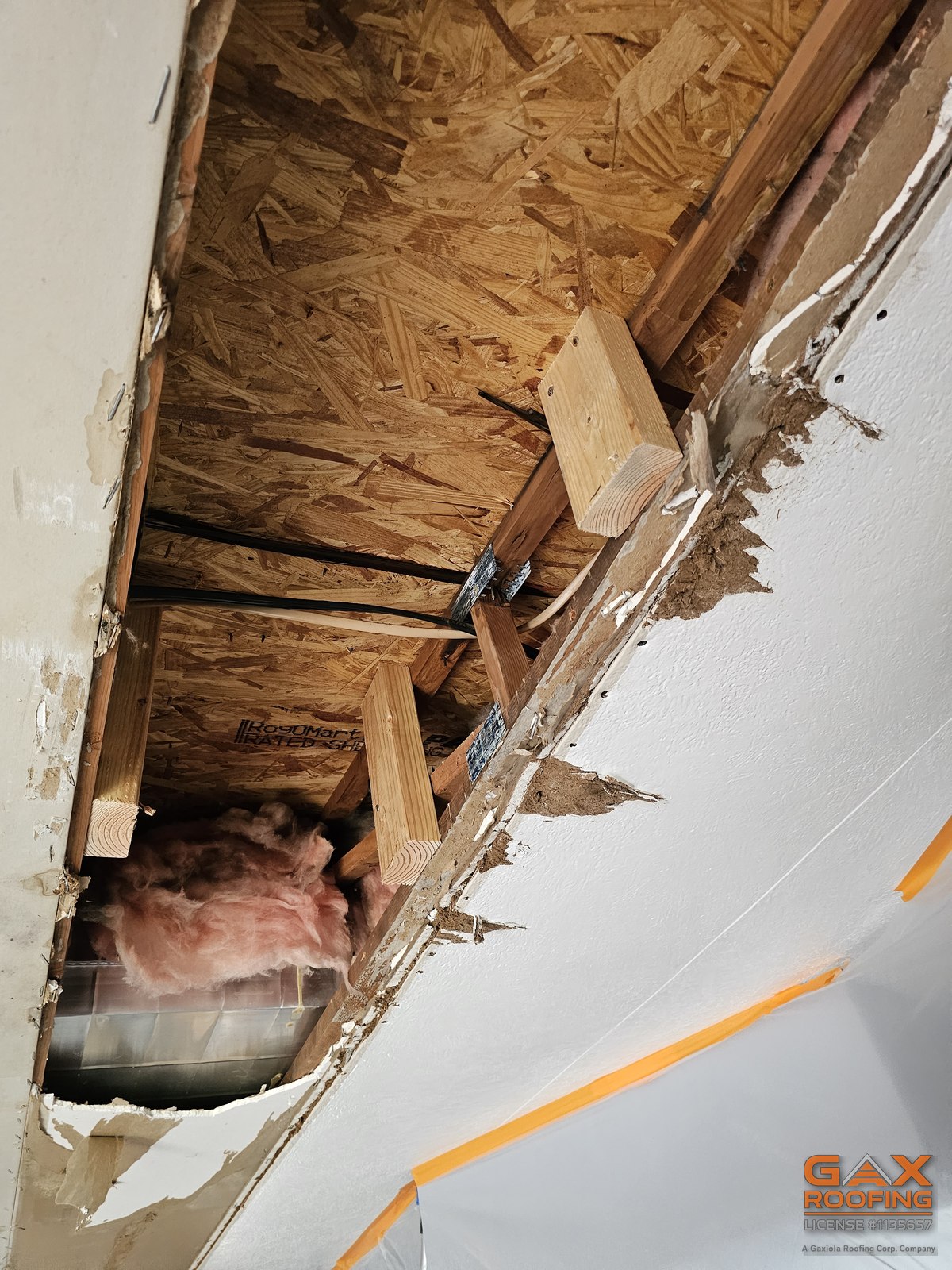
A different home, in Brea: a roof leak that went too long. This is where the water ends up when nobody stops it.
Then there's mold. The EPA says water-damaged areas and items need to be dried within 24 to 48 hours to prevent mold growth. Two to four weeks on an adjuster's list is a lot longer than 48 hours.
The claim can wait. The water can't.
The Wait Can Cost You on the Claim Too
Here's the part a lot of people don't know. The same Department of Insurance guide says a policy may not cover the damage that follows if you didn't take reasonable steps to protect the house. It also says to find and stop a leak at the source right away, because putting off the drying can lead to mold.
So waiting for the adjuster before you do anything isn't playing it safe. It can be the opposite.
What to Do While You're on the List
Filing a claim and protecting your house aren't either-or. Do both.
Report the claim right away. Those deadlines start when the insurance company gets notice of your claim, so the sooner you call, the sooner the clock starts.
Take pictures before anything gets covered. The ceiling, the stains, the attic if you can get up there safely, and the roof from the ground. Save the original files.
Stop the water. The guide calls temporary repairs one of the most important things to do after a loss, like covering a damaged roof with plastic sheeting. A tarp over the bad section, a bucket in the attic. Don't climb on a wet roof to do it. That's what we're for.
Keep every receipt. If the loss is covered, the guide says reasonable costs to protect the property get reimbursed, as long as you save the receipts.
Keep a log. Every call and email with the insurance company: the date, who you talked to, what they said. The guide recommends it, and it helps if things drag on.
Hold off on the big repair, not the tarp. The guide says not to make extensive permanent repairs until the adjuster has seen the damage. A tarp isn't that. It's how you keep the damage from growing while you wait. Here's what happened when a homeowner in Fontana held off on everything: the rain beat the claim.
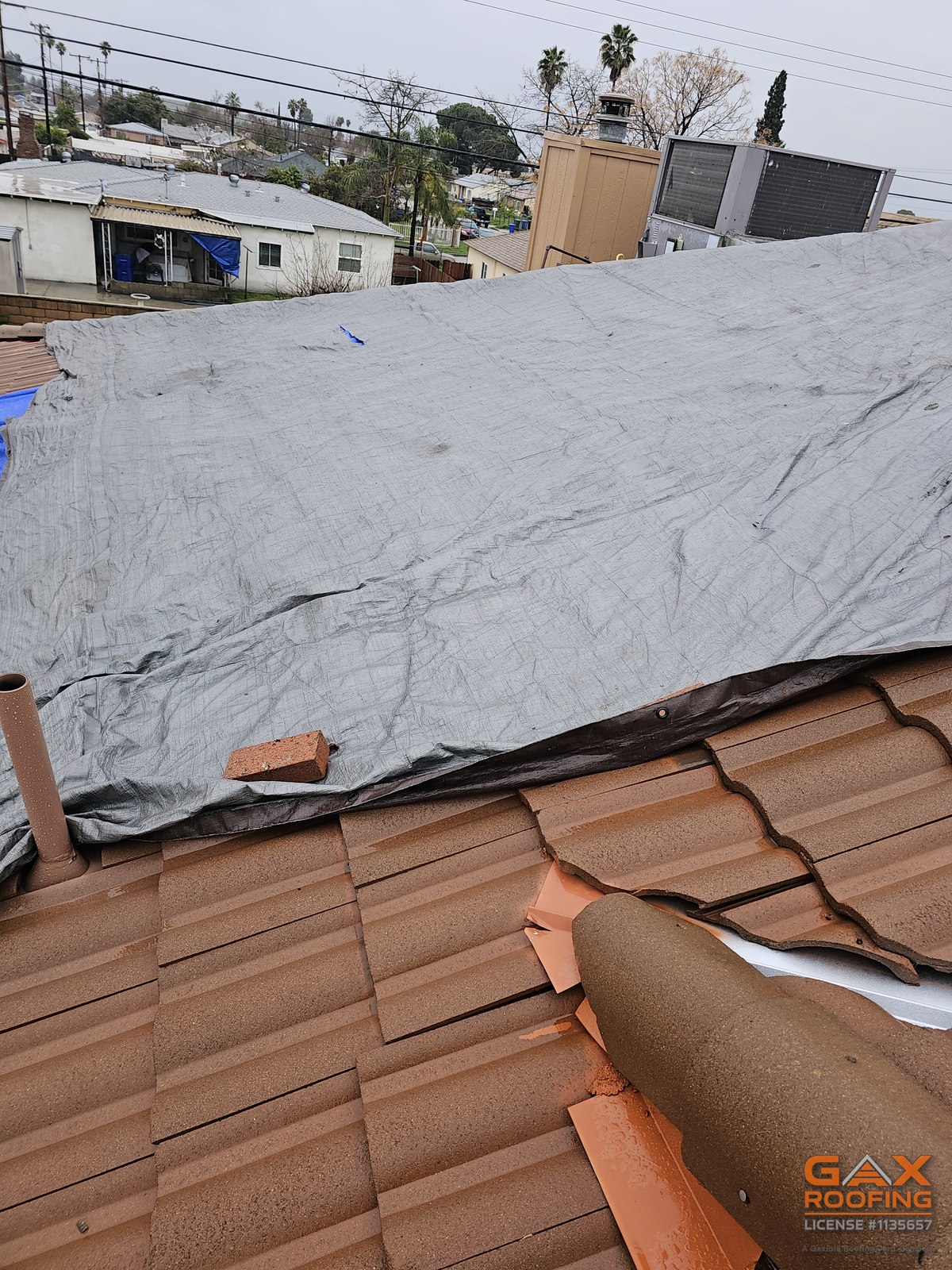
An emergency tarp on one of our calls in Tustin. A tarp is a stop, not a roof, but it keeps the water out while the claim catches up.
For the first hour of an active leak, our guide on what to do when your roof leaks in a storm walks through it step by step.
Where We Come In
Call us when it leaks, not after the adjuster comes. We'll come out, find where the water is getting in, photograph what we find, and tarp it if it needs one.
When the adjuster does come out, we can be there to show them the damage and explain what the repair involves. The claim stays between you and your insurance company. What's covered is up to your policy and your insurance company after the deductible. A lot of policies cover wind, and they usually exclude wear and tear.
If you need a written report with dated photos to send in, we can put one together. It's free when we do the repair, and a separate service if all you need is the report. More on storms and insurance is on our storm damage page.
Sources: California Department of Insurance, Residential Property Claims Guide (Form 405, revised February 28, 2025); Cal. Code Regs. tit. 10, § 2695.5(e) and § 2695.7(b) and (c)(1); EPA, A Brief Guide to Mold, Moisture and Your Home.
Leaking While You Wait on a Claim?
Free estimate, in writing. We'll find where the water is getting in, and tarp it if it needs one. We do asphalt shingle roofs, tile replacement with new tile, tile lift and relay, and flat roofs across the Inland Empire.
(909) 819-8394
Book an Estimate