Roof Overlay vs. Tear-Off
"Can you just go over the old shingles?" Sometimes it is legal. It is almost never smart. Here is California's two-layer rule, what an overlay hides, and the bill that shows up a few years later.
"Can you just go over the old shingles?" Sometimes it is legal. It is almost never smart. Here is California's two-layer rule, what an overlay hides, and the bill that shows up a few years later.
"Can you just go over what's there?" I hear it on about every third shingle estimate. The honest answer has two parts. Part one: sometimes, yes, the code allows it. Part two: we do not do them. GAX rejects overlays, and I will show you why with numbers instead of adjectives. If you still want one after reading this, call me anyway. I would rather look at your roof and tell you what it actually has under it than watch you hire the guy who says yes to everything. This post is the whole conversation, so you can have it without me in the room.
An overlay (some roofers say layover, recover, or re-roof) means the crew leaves your existing shingles where they are and nails a new layer right over them. No demo, no dumpster, done in a day or two. That is the whole sales pitch, and it is a real one: tear-off labor and disposal are a real chunk of a shingle job.
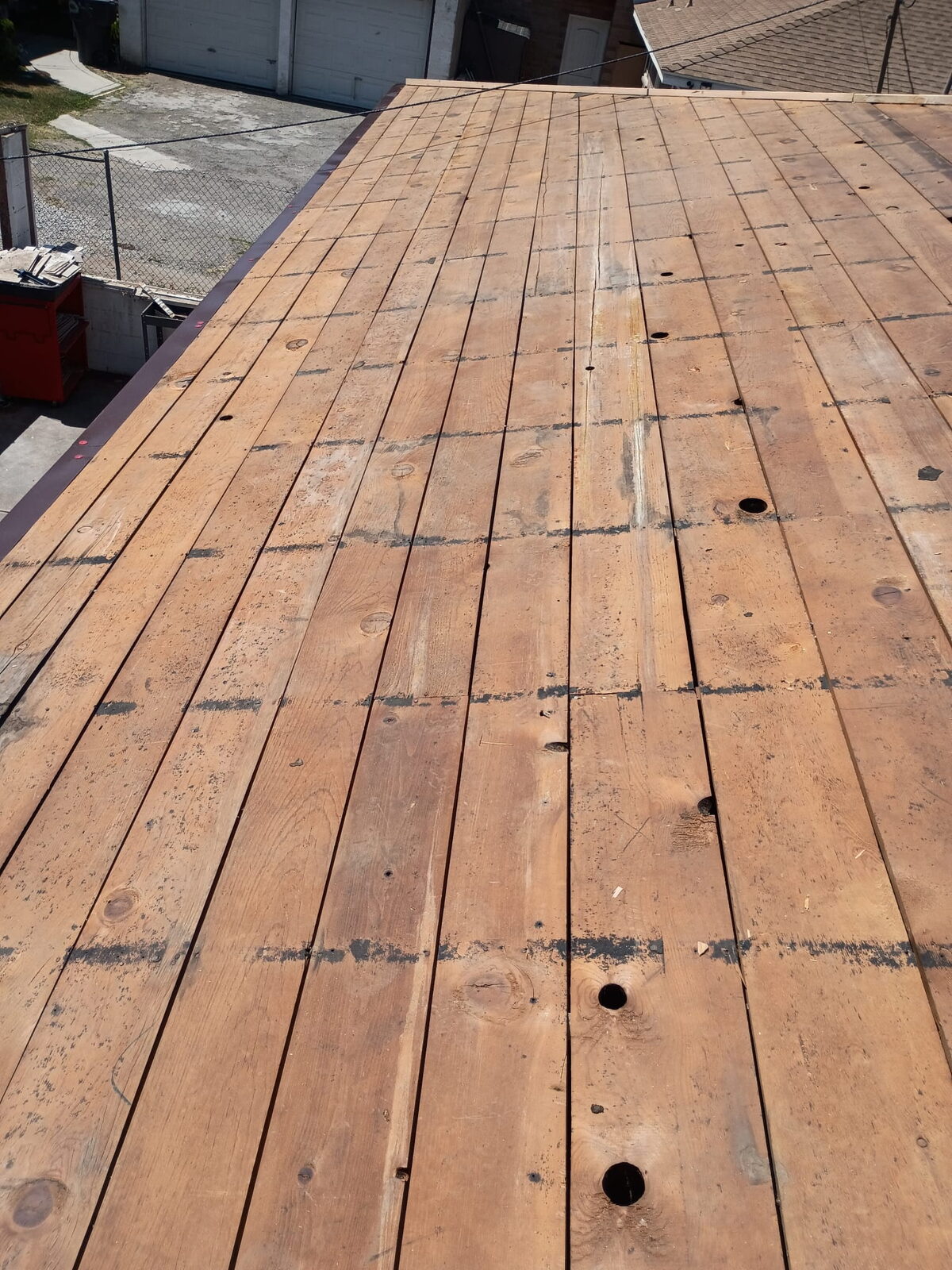
A tear-off means everything comes off down to the wood. Old shingles, old underlayment, old flashings, old drip edge. The deck gets walked, probed, and repaired where it needs it. Then the new system goes on from the bottom up: underlayment, flashings, starter, shingles, ridge, ventilation. It costs more on day one because it is more work. It is also the only version where anyone actually sees what your roof is sitting on.
California's residential code (CRC R908.3.1.1, if you want to look it up) does not allow a new roof covering over an existing one when any of these are true:
Our own city puts the shake rule in writing. Rancho Cucamonga's re-roofing policy (Building & Safety handout 0029, Revision D, August 2020) says it in one line: "New roof cover covering shall not be applied over existing wood shake roofs." Same document caps asphalt at one overlay over an existing asphalt roof, and requires Planning approval before you change roof material. Other cities word it differently, but I have not worked in one that lets you shingle over shake.
Permits are required either way, in every city we work. Overlay or tear-off, if the roofer says the permit is optional, that is your answer about the roofer.
No made-up dollar ranges here. Every roof is different and I would rather you get a real number from us than a fake one from a blog. These are the things that are true on every job.
| What | Overlay | Tear-off |
|---|---|---|
| Cost today | Lower. Skips the demo and the dump. | Higher. Demo, disposal, deck repairs. |
| Days on site | Usually 1 to 2. | Usually 2 to 5. |
| Your deck | Never seen. Whatever is rotten stays rotten. | Walked, probed, repaired where it needs it. |
| Flashings | The old ones stay, or get patched around. | All new: step, counter, pipe jacks, drip edge. |
| Underlayment | The old paper stays under there. | New. This is the part that keeps water out. |
| Ventilation | Whatever you already had. | Brought to current standard. |
| Heat | Two layers trap it. In the Inland Empire that matters. | One layer, vented. |
| Weight | Adds a second layer your framing was not designed for. | Back to the original design load. |
| Manufacturer warranty | Basic material coverage at best, and it excludes leaks caused by whatever is underneath. Owens Corning's system warranty requires a clean deck with all existing roofing removed. Malarkey's Emerald Premium says re-covering is not acceptable. | Eligible for the full system warranty, the one with labor and workmanship coverage. |
| Resale and insurance | Two layers get flagged by home inspectors, and California carriers are looking harder at roofs. | Reads as a new roof, because it is one. |
| Code | Only if you have exactly one layer today. | Always allowed. Required once you have two. |
| Your next roof | A double tear-off, at that year's price. | A single tear-off, decades from now. |
A shingle roof in Rancho Cucamonga, Fontana, or Riverside spends the summer cooking. Your attic sits at 150-plus degrees with the sun on it. Now put a second layer of asphalt on top of the first. The old layer cannot shed heat anymore, the new layer sits on a mattress of hot shingle instead of a vented deck, and both of them age faster than they were rated to. Overlays in cooler climates are a compromise. Overlays out here are a compromise with the thermostat pinned.
Three things, and they are the three things that actually decide whether a roof leaks. The deck: soft spots, rot, the plywood a previous owner never fixed. The flashings: the metal at every wall, chimney, and pipe, which is where most leaks start and which an overlay leaves in place. And the underlayment: the paper under the shingles that does the real waterproofing, which stays old and brittle under the new layer.
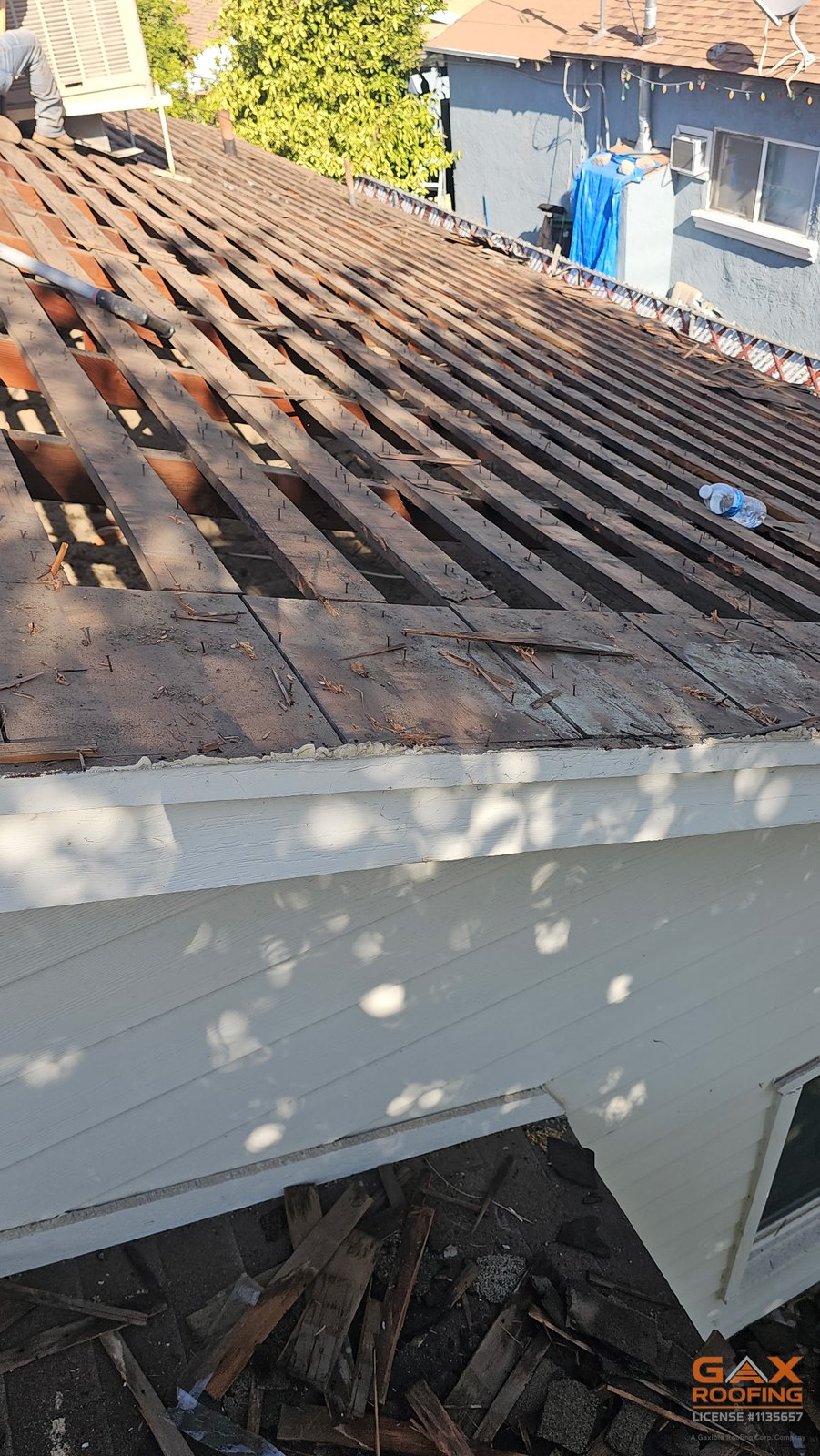
The Colton house is the extreme version: shingles over wood shake so dry it crumbled under my crew's boots, on skip sheathing that could never have held shingles in the first place. Nobody knew until the tear-off. That is the point. Nobody ever knows until the tear-off.
Here is the part the overlay pitch never includes. Every layer you add is a layer somebody has to tear off later, and the price of that job does not sit still. Our material suppliers raise prices roughly 2 to 4 percent every quarter. Not every year. Every quarter. It is not just roofing, either. Everything has been going up. Even Apple, a company with more cash than most countries, said this year it could not keep absorbing what memory chips cost and raised prices across most of its lineup. If Apple cannot eat its material costs, your roofer cannot either.
Real numbers. A homeowner recently handed me a bid we wrote in 2022: 22 squares, two layers to tear off, $585 a square, $12,870 for the whole roof. The same roof today prices at $787 a square, $17,314. Same house, same two layers, about $4,400 more, because it waited four years. Yes, the 2022 number looks crazy now. It was real.
An overlay does not make that bill smaller. It adds a layer to it and moves it to a more expensive year. And because California stops at two layers, an overlay is the last time you get to kick the can. The roof after that is a full double tear-off, no exceptions.
I am not going to pretend the code never allows one. Another roofer can legally offer you an overlay when all of these are true at once:
If every one of those is true, I will tell you so, and you will leave the conversation knowing exactly where your roof stands. On a 20-year-old Inland Empire roof, every one of those is rarely true anyway. And notice that even GAF, a company that sells the shingles for the overlay, says the same thing to its own contractors: one layer, lying flat, no history of leaks, or do not do it.
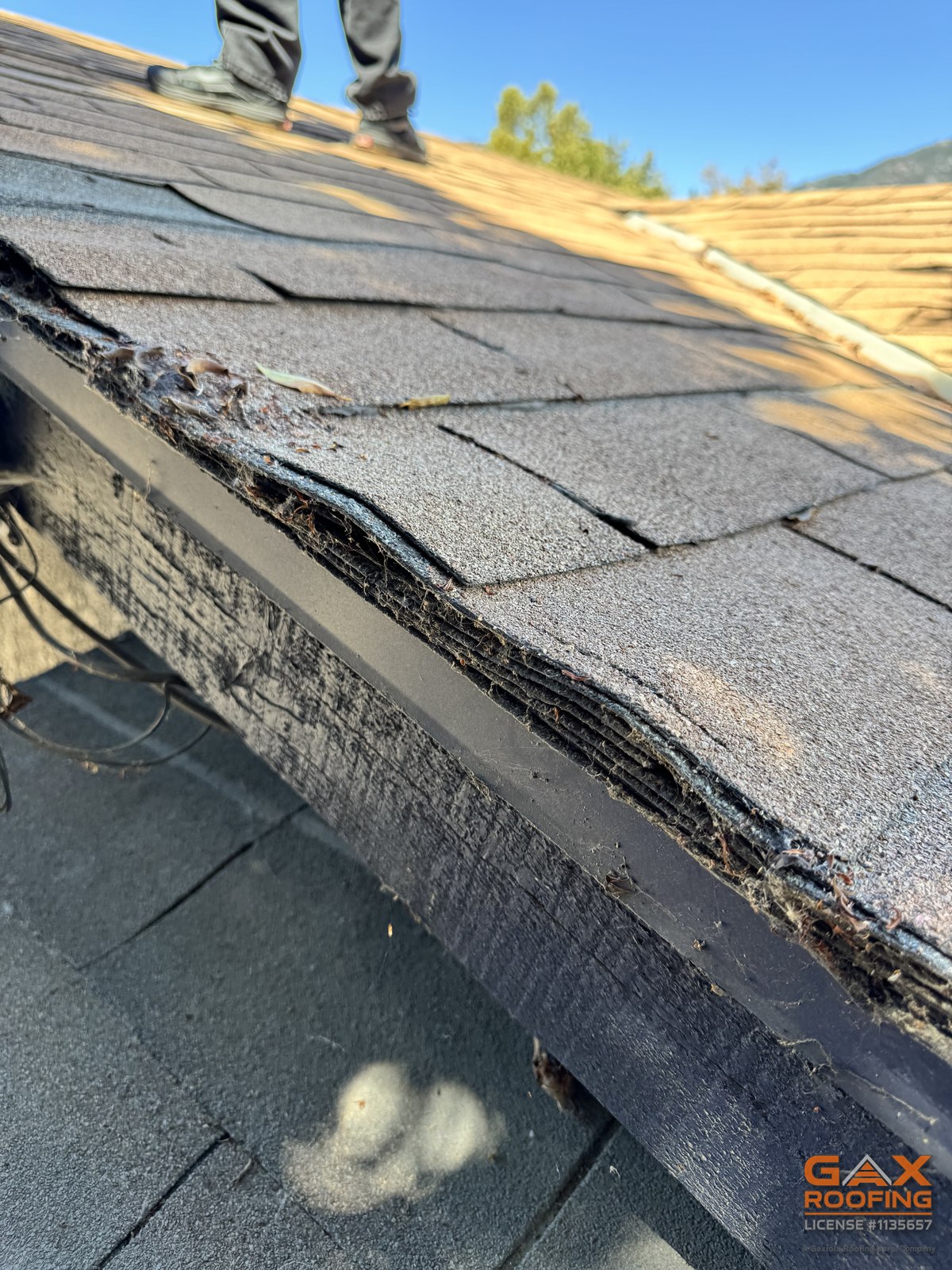
This is what the first one looks like from the edge. Highland, inspection this week. Count the layers at the rake: at least three, on a roof California caps at two, with years of debris packed between them. The homeowner called because the roof was leaking and was surprised. The leak was never the surprise. It was the only outcome left.
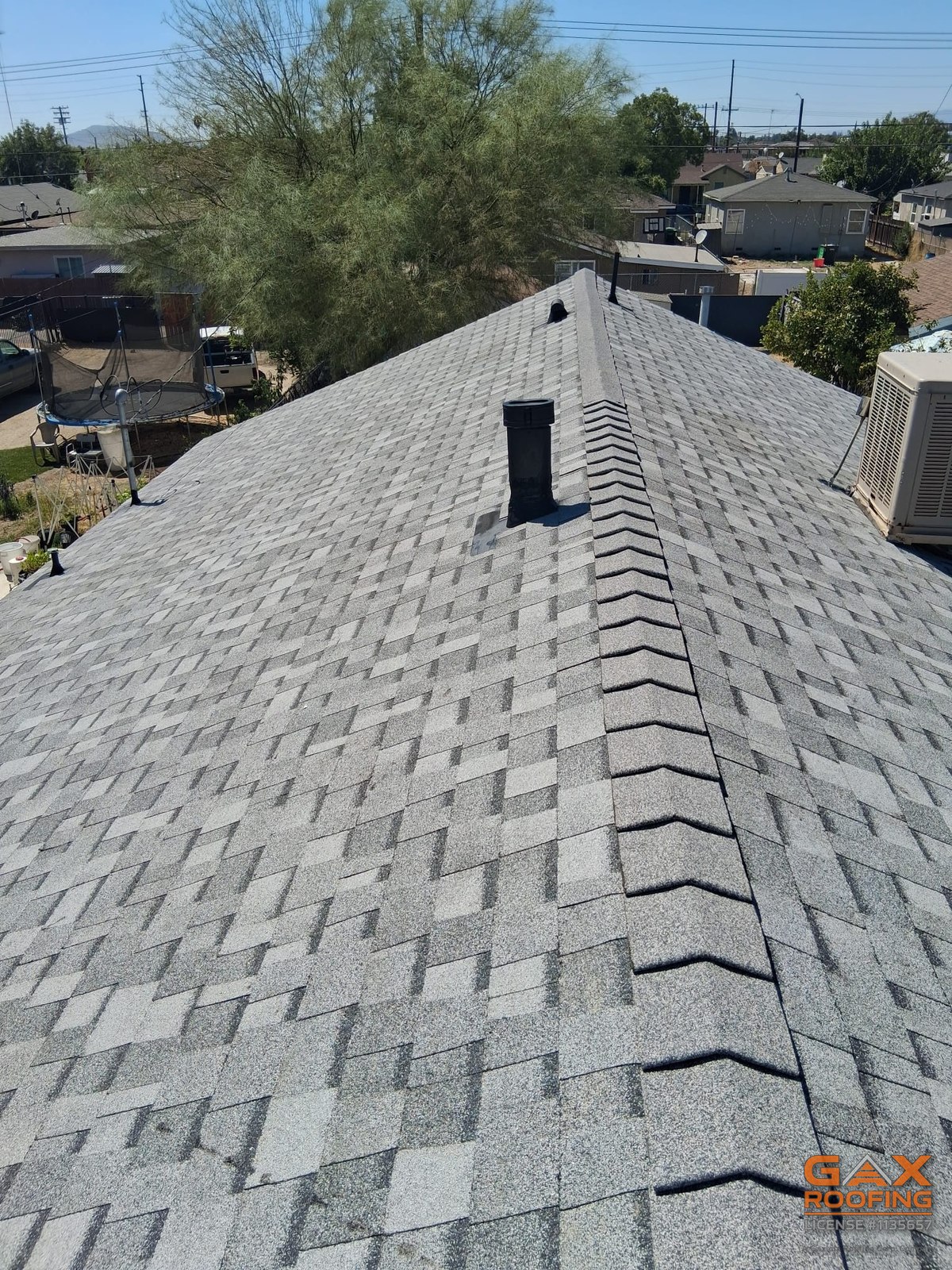
We reject overlays. Every shingle roof we sell is a tear-off, so this is the only version of the job you will get a number for. Everything off, down to the deck. The deck inspected and repaired where it needs it, in writing. New synthetic underlayment across the whole roof and a peel-and-stick barrier at the valleys and penetrations. All new flashings and pipe jacks. Ridge ventilation cut in. Cool-rated shingles on top. The permit pulled by us, under our license, and the whole thing documented from tear-off to final walkthrough so you can see what you paid for. The full system is on the shingle roofing page, and how we price it is on the roof replacement page.
"The overlay will always come back to bite you. Do it right once, at today's price, because today's price is the cheapest one you will ever see."
Can you put new shingles over old shingles in California?
Only if the roof has exactly one layer today, the existing shingles are sound and flat, and the deck under them can hold nails. Two layers means a tear-off, no exceptions. Tile, and shake on skip sheathing, are never overlaid.
How many layers of roofing does California allow?
Two. That is the ceiling under the California Residential Code, and it counts every type of roof covering, not just shingles.
Is an overlay cheaper?
On the day you write the check, yes. Over the life of the house, no. You skip one tear-off now and buy a double tear-off later, at a price that has been climbing 2 to 4 percent a quarter. The 2022 bid in the Colton story is the real-world version of that math.
Does an overlay void the shingle warranty?
The basic material warranty usually survives, but read the exclusions: Owens Corning will not cover leaks caused by "pre-existing conditions" or "underlying roofing materials," which is the entire risk of an overlay. The real system warranties are simply not available. Owens Corning's Preferred Protection requires "a clean roof deck with all existing roofing material and debris removed." Malarkey's Emerald Premium says "installing over existing roofing materials (i.e., re-covering) is not acceptable. A complete tear-off is required." Ask to see the warranty terms before you agree to an overlay, not after.
Can you overlay a tile roof?
No. Slate, clay, and concrete tile are excluded by code. If your tile is sound and the underlayment is what failed, the fix is a lift and relay, not a layer on top.
Do I need a permit for an overlay?
Yes, same as a tear-off. If a roofer tells you otherwise, or hands you an owner-builder permit to sign, that is the end of the conversation.
We will look at the eave, check the attic, and tell you straight how many layers you have and what the tear-off actually costs. We do not do overlays, so you get one honest number instead of two. No pressure, in writing.
(909) 819-8394