The Part of Your Tile Roof That Actually Wears Out
Tile roofs have a reputation for lasting forever, and honestly, that reputation is mostly earned. According to Eagle Roofing, one of the largest tile manufacturers in California, concrete and clay roof tiles can last 50 to 75 years or more with proper maintenance. In the Inland Empire, I regularly walk tile roofs where the tiles themselves are in solid shape. No cracks, no chips, color still holding up.
But here's what most tile homeowners don't know: the tiles are only one part of the system. Underneath them sits the underlayment, typically an old 30-pound felt, and that material has a lifespan of about 30 years. When the underlayment goes, the tiles above it become essentially decorative. Water gets in, finds the failed felt, and the interior of your home starts paying the price.
The math on this is pretty clear. If your tiles last 75 years and your underlayment lasts 30, every tile home is going to need at least one underlayment job during its lifetime. That's not a scare tactic, it's just how the system is built.

Tiles being carefully removed and staged during a lift & relay job in the Inland Empire.
So What Exactly Is a Tile Lift & Relay?
A tile lift & relay, sometimes called a tile reset, is exactly what it sounds like. We carefully remove your existing tiles from the roof, set them aside, strip out the old failed underlayment down to the deck, and install a new high-performance underlayment in its place. Then we reinstall your original tiles on top.
The result is a roof with a brand new waterproofing system underneath, and your original tile sitting right back where it was. For homeowners whose tiles are in good shape, this is significantly more cost-effective than a full replacement, because we're not buying new tile material, just the labor and underlayment to restore the waterproofing layer that's actually failed.
The underlayment we use for these jobs is Titanium PSU30, a peel-and-stick synthetic underlayment that's a major upgrade over the original 30-lb felt. It's more durable, more watertight, and rated to perform in the extreme heat cycles the IE puts roofs through every summer.
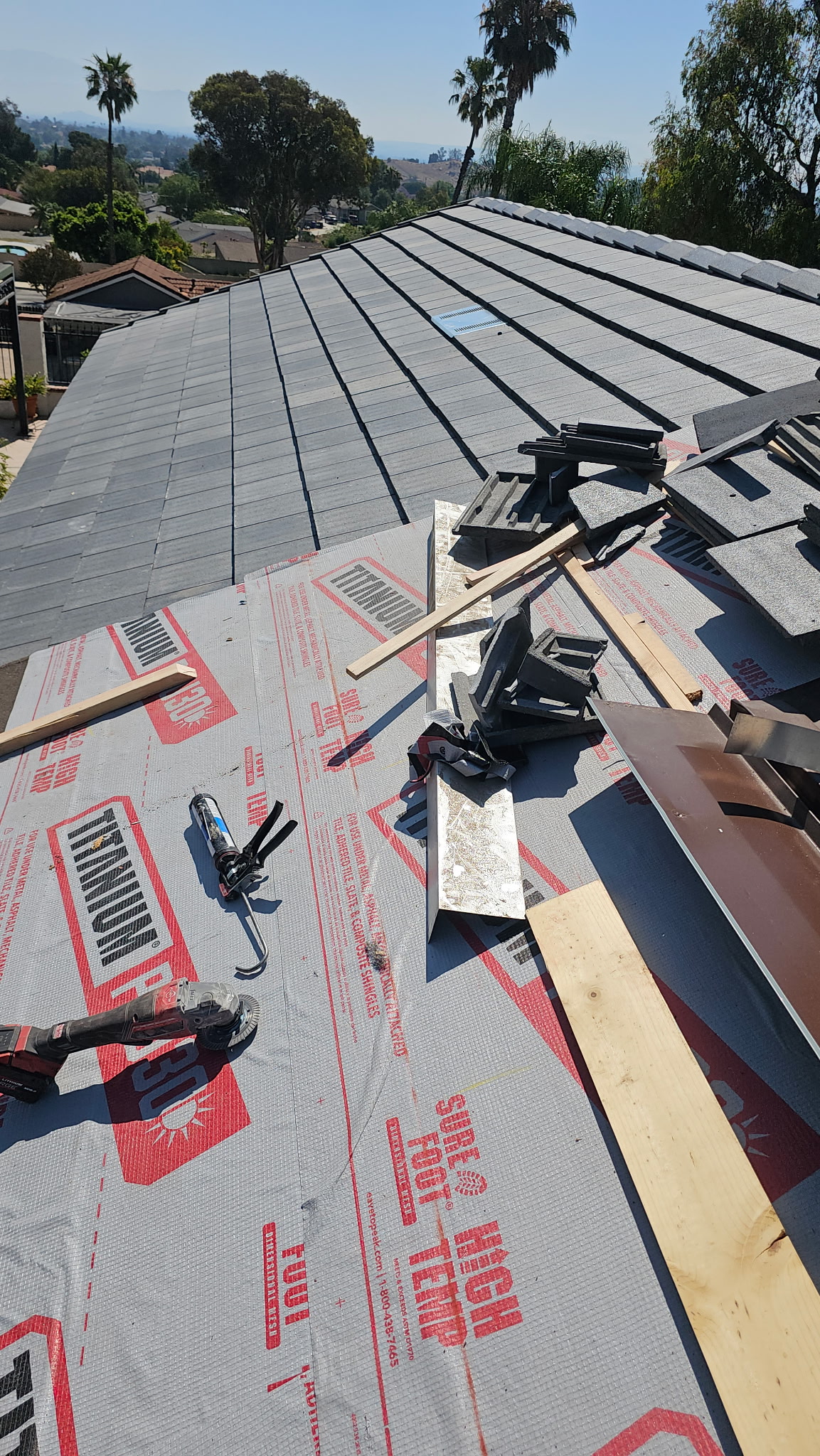
Titanium PSU30 peel-and-stick underlayment going down before the tiles are reinstalled.
How Do You Know When It's Time?
There are three things I look for, and honestly, any one of them is enough to have the conversation.
- Multiple leaks showing up in different spots. One leak can be a broken tile or a failed flashing. Two or three leaks in different areas of the same roof is almost always underlayment failure. The water is finding its way through wherever the felt has deteriorated, and you'll keep chasing leaks indefinitely until the underlayment is replaced.
- The underlayment disintegrates when touched. When I walk a tile roof and lift a tile to inspect, old failed felt will crumble in your hand. It turns to powder. When you're at that stage, the material has completely lost its ability to shed water, it's basically just disintegrated paper sitting between your tiles and your deck.
- Tiles are dislodging or sliding on their own. To be precise about this: the underlayment does not hold tile on the roof. The fasteners, battens, clips, or foam do. What old felt does is let water past it, and water rots battens, corrodes nails, and swells the deck, and then tiles start to slip. So when I see tiles sitting at odd angles, or coming off entirely, I look at the fastening and the battens first, and the felt under them is usually the reason those failed.
"When I lift a tile on an old roof and the felt crumbles in my hand, there's no repair that fixes that. The whole underlayment has to come out. The only question is whether we're doing a lift and relay or a full replacement."
Why Dislodging Tiles Make the Problem Worse, Fast
Here's something that catches homeowners off guard: a tile that's slipping or coming loose doesn't just create an opening for water. It actively accelerates the damage to the underlayment underneath it.
When a tile shifts or pulls away, it tears the old felt beneath it. Now you have a breach, and once water gets through a breach in deteriorated felt, it spreads. Wet felt disintegrates faster than dry felt. So the leak that started in one spot starts spreading laterally through the underlayment, and what looked like a localized problem becomes a much bigger one within a single rainy season.
This is why I always tell homeowners: if you're seeing tiles slip or come off, don't wait. The longer you wait, the larger the area of failed underlayment you're dealing with, and the more likely you are to have deck damage underneath it as well.
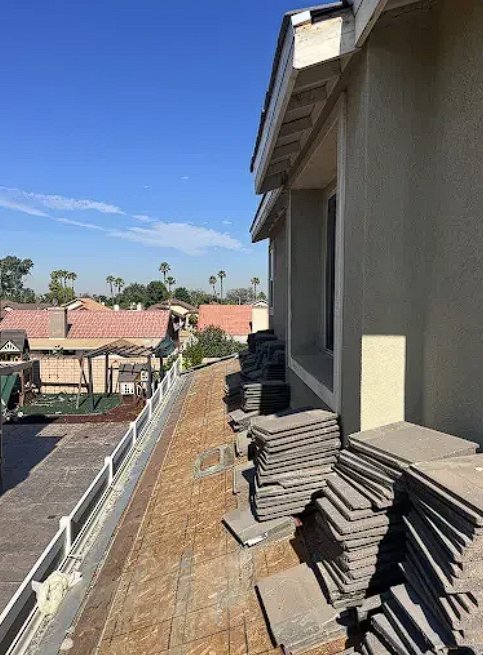
Existing tiles carefully staged during a relay, these go right back on once the new underlayment is down.
Why a Full Facet Beats a Spot Fix Every Time
I get asked sometimes whether we can just do a section of the roof, and the answer is yes, we can absolutely do full facets. A facet is one plane of the roof, one section between ridges and valleys. If the back of your roof is failing but the front looks okay, we can lift and relay just that portion.
What I don't recommend is a "spot fix" on a tile roof with deteriorating underlayment. Patching one area of failed felt while leaving the rest intact doesn't solve the underlying problem, it just defers it. You'll be back in the same conversation in 12 to 18 months when the next section fails.
A full facet lift & relay gives you a genuinely fixed section of roof with a new underlayment that's going to perform for decades. It's more work than a patch, but it's actually the more economical choice when you factor in the cost of repeat repairs and the growing water damage in between.
Lift & Relay vs. Full Replacement, Which Do You Need?
When a homeowner has a tile roof with underlayment failure, the choice usually comes down to one of two paths: a lift & relay if the tiles themselves are in good condition, or a full tile replacement if the tiles are cracked, broken, or the homeowner wants to change the style entirely.
Both are the right way to do it, as opposed to a spot patch, which is almost never a long-term solution on a tile roof. The decision really comes down to tile condition and budget. If your tiles are intact and you want to keep the same look, a lift & relay gets you a new roof system at a lower cost. If you have significant tile damage or you're ready for a change, a full replacement makes more sense.
Either way, I'll give you a straight read on the roof when I come out. If a lift & relay is the right call, that's what I'll recommend. If the tiles are too far gone to reuse, I'll tell you that too.
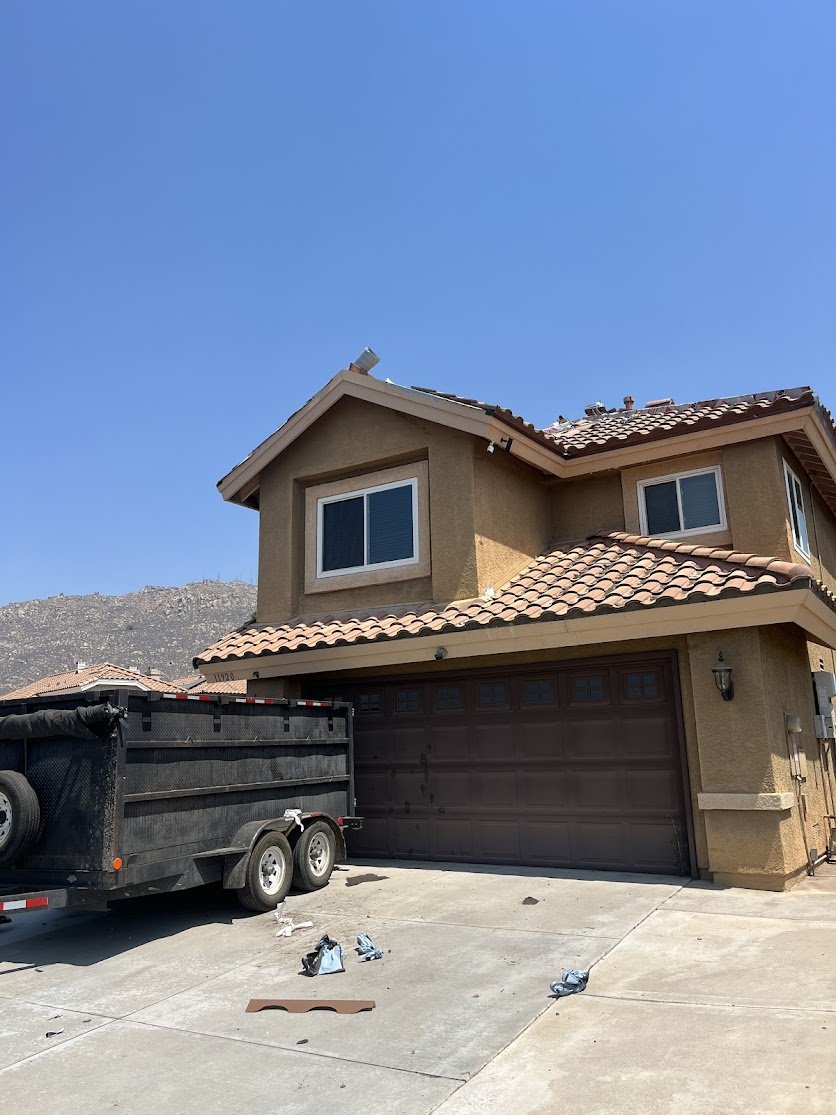
A tile lift & relay job in progress, the existing tiles come off, underlayment gets replaced, tiles go back on.
Want a ballpark number before you call?
Use our free roofing calculator to get an estimated cost for a tile lift & relay based on your roof size. No sign-up, no obligation, just a realistic starting point.
Try the Calculator →
The Bottom Line
If you have a tile roof and it's 25 to 30 years old, or if you've been dealing with leaks that keep coming back in different spots, the underlayment is almost certainly the issue. The tiles look fine, they're supposed to last another 40 years, but the waterproofing layer underneath them has run its course.
A tile lift & relay is the right fix. It's more cost-effective than a full replacement when the tiles are in good shape, and it's infinitely more effective than chasing leaks with patches that don't address the actual failure point. Done right on a full facet or full roof, it's a permanent solution, not a band-aid.
If you're in Rancho Cucamonga, Ontario, Fontana, or anywhere in the Inland Empire and you suspect your tile underlayment is failing, give us a call. I'll come out, walk the roof, and tell you exactly what we're dealing with.
Tile Roof Leaking? Let's Take a Look.
We come to you, inspect the underlayment, and give you a straight answer, lift & relay, full replacement, or something else. Free estimate, no pressure.
(909) 819-8394
Send Us a Message