The bid tells you what a roofer plans to do. The contract is what you can hold them to. Here is a five-minute check before you sign, with the California rule behind each line.
Sign when every line below has an answer in writing. If the contract is silent on one, ask for it to be written in before you sign, not after. A promise that isn't on the paper isn't part of the deal, and that goes for every roofer on your table, us included.
Good to sign when it has
A license number you looked up yourself on the CSLB site: active, the same name, roofing (C-39) among the classifications
The roof areas, the tear-off and every product named by manufacturer, line and color
Who pulls the permit, in writing
A down payment no bigger than $1,000 or 10 percent of the price, whichever is less
Progress payments tied to finished stages of work
A start date and a completion date
Changes only by signed change order
The workmanship warranty, in writing
The notice of your right to cancel and the mechanics lien warning
No blank spaces in the copy you sign
Stop and ask if you see
No license number, or one that comes back expired, suspended or under another name
A down payment above the legal limit
"Title 24 compliant" or plain "underlayment" with no product name
A request that you sign the permit as an owner-builder
Something promised out loud that isn't written in
A payment due before the matching work is done or the materials are delivered
Step 1
Who You're Hiring
Look the license up yourself
Every California contractor has to print the license number on bids, contracts and ads. Type it into the CSLB license check and confirm the license is active, the name matches the company on the contract, and roofing (C-39) is among the classifications. The lookup also shows the address of record and the bond.
Workers' comp is not optional for roofers
CSLB requires every active C-39 roofing contractor to carry workers' compensation insurance, or have a self-insurance certificate on file, whether or not they have employees. It shows on the license lookup. If a worker is hurt on your roof and the contractor isn't covered, you could end up paying.
The contract names the insurance
A licensed contractor has to give you information about workers' compensation and commercial general liability insurance in the written contract. General liability isn't required by law, but it's what pays for damage to your property, so if a contractor has none, ask how damage would be covered.
The person at your table
Ask to see the pocket license and a photo ID, and make sure it's the same person. A salesperson working for a contractor has to be registered with CSLB as a Home Improvement Salesperson and carries a registration card.
On a GAX contractGAX Roofing is Gaxiola Roofing Corp., California C-39 license #1135657. Our contracts list our workers' comp and general liability carriers. Check us the same way you check anyone: our license and insurance page.
Step 2
What Goes on Your Roof
California expects the contract to describe the work and the products in detail: what gets installed, size and color, who does what, and the manufacturer's model. On a roof, that means which sections are in the job, the tear-off, the deck and every layer by name. Our bid comparison guide goes through the scope line by line; here's the short version for the paper you're about to sign.
The whole roof, or which parts
If only part of the roof is in the job, the contract should say which sections, ideally on a diagram attached to it. A house with a garage, a patio cover and an addition has more than one roof.
Tear-off and layers
The old roof comes off down to the deck, and the contract says how many layers the price covers and what happens if another one turns up.
Products by manufacturer, line and color
"Title 24 compliant shingles" or plain "underlayment" names nothing. The contract should name the product, the line and the color you picked, and the underlayment by product name too.
The deck: allowance and rates
Nobody sees the deck until the old roof is off. The contract should say how much damaged wood is in the price and what wood past that costs, per sheet and per foot.
Flashing and ventilation
New flashing at walls, chimneys, pipes and valleys, and the ventilation by type and amount, not just the word "vents."
Cleanup and exclusions
Who hauls the old roof away and how often the site is cleaned, plus a plain list of what the price does not include.
On a GAX contractWe name the field material and the underlayment by product, and if a product becomes unavailable, the substitute comes to you in writing for approval before it goes on. Every shingle job is a full tear-off. Unless the job includes a full resheet, the first 60 linear feet of shiplap, or OSB equal to 10 percent of the deck area (rounded to whole sheets), is included, and the unit rates for anything past that are printed in the contract.
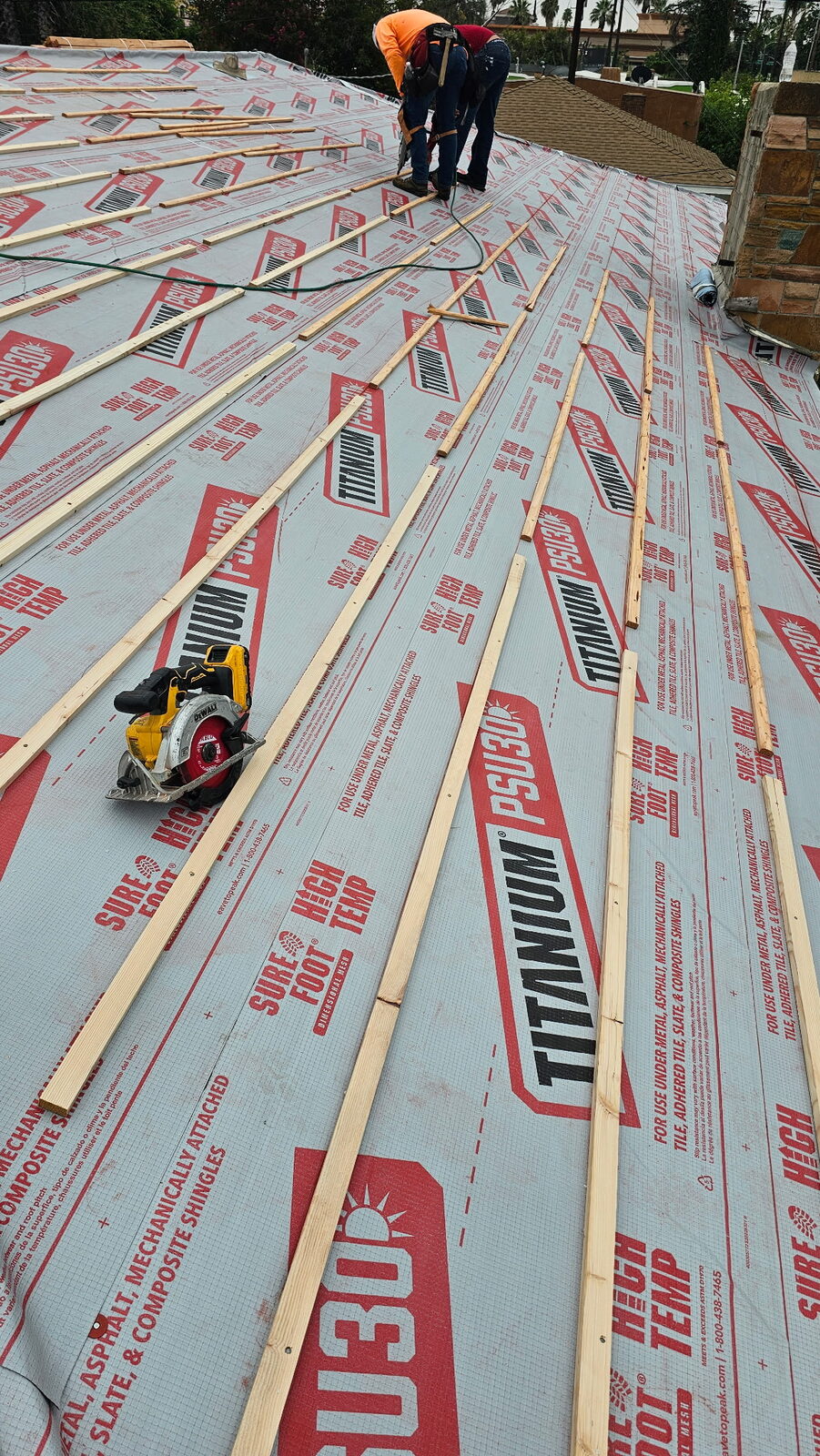
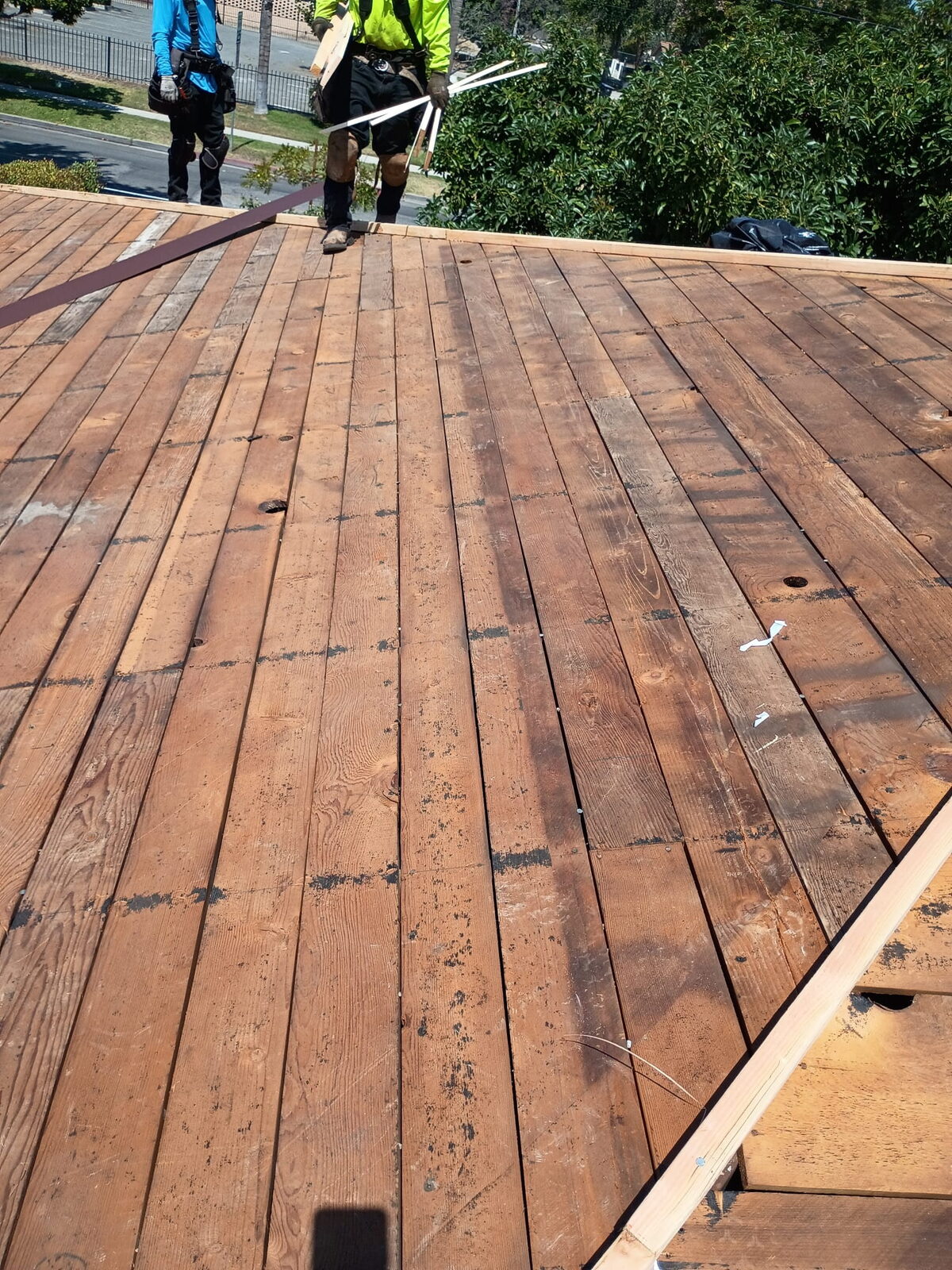
Titanium PSU30 going down on a tile roof. The name printed on the roll is the name that belongs in the contract.A board deck after the tear-off. This is when the wood allowance in the contract starts to matter.
Step 3
Who Pulls the Permit
The contract has to say who gets the permits, and CSLB suggests checking whether the permit fee is in the price. What needs a permit depends on the city or county and the scope, so the building department for your address has the final word.
In writing, under whose license
The normal arrangement is that the licensed roofer pulls the permit under their own license and schedules the inspections. Ask whether the fee is included or billed at cost with the receipt.
Owner-builder paperwork is a stop sign
If a roofer asks you to sign the permit as the owner-builder, the legal responsibility for the work moves from the contractor to you. If anyone slides owner-builder paperwork across your table for a roof they're supposedly building, that's the end of the conversation. More in our owner-builder warning.
On a GAX contractWe pull the permit under our license and schedule the inspection, and the proposal says whether the fee is included or reimbursed at cost with the receipt.
Step 4
The Money Rules
Down payment: $1,000 or 10 percent, whichever is less
That's the legal limit on a home improvement contract in California, and special-order material is not an exception. On a $14,000 roof, the most anyone can collect up front is $1,000. On a $7,500 job, it's $750. The only exception is a contractor with a blanket performance and payment bond on file with CSLB, and CSLB counts about two dozen of those.
Progress payments follow the work
Each payment should be tied to a described stage of work. The contract itself has to warn you that it is against the law for a contractor to collect payment for work not yet completed or materials not yet delivered. Pay as the work is done, not before.
Lien releases as you pay
California home improvement contracts carry a statement that once you pay for a portion of the work, the contractor gives you a full and unconditional lien release for that portion before any further payment. Ask for it.
The total, in one number
The contract price should be one stated total, with any add-ons or options listed as their own lines, so the payments add up to it.
On a GAX contractOur down payment follows the legal cap, and our progress payments are tied to stages of the job, like material delivery or the tear-off being complete, with the final payment at substantial completion.
Step 5
Dates and Delays
A start date and a completion date
The contract has to give approximate dates for both. California law makes it a violation for a contractor, without lawful excuse, to fail to substantially start the work within 20 days of the approximate start date in the contract.
What counts as started
A good contract defines it. Ours counts the delivery of roofing materials or the start of tear-off, tile lifting or other work on the roof, whichever comes first.
What can honestly move the schedule
Rain, permit and inspection scheduling, material delivery, and deck repairs approved at tear-off. When a date moves, it should be confirmed in writing, by email or text at the time, not as a surprise at the end.
Step 6
Changes Only in Writing
Signed before the work, not after
Any change to the price or the scope has to be a written change order, signed by you and the contractor before the change is made. It should say what the extra work is, what it adds or subtracts, and how it changes the payment schedule.
Verbal promises
If somebody promised you something at the table, it belongs in the contract before you sign. That goes for every company, ours included.
On a GAX contractNo chargeable wood goes on a GAX roof on a verbal say-so. We photograph it, write up the quantity and the price, and it goes in after you sign. The one exception is emergency dry-in to keep water out of the house, which gets written up within one business day.
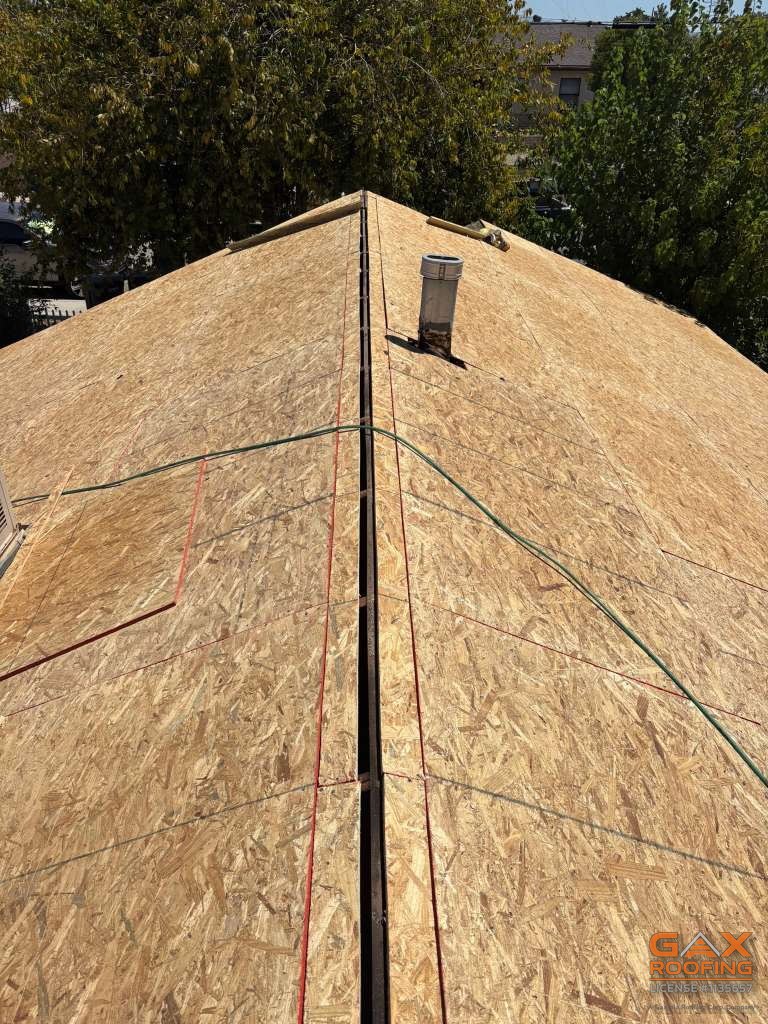
Colton: new OSB going over old skip sheathing that nobody could see until the tear-off.
Step 7
Two Warranties, Both in Writing
CSLB's advice is to get any warranty on labor and materials in writing. A new roof usually comes with two, from two different companies.
Workmanship
The roofer's promise about the installation: how long it lasts, what it covers, and whether it transfers if you sell.
Manufacturer
The materials warranty, on the manufacturer's own terms. Ask who registers it and get the registration information.
On a GAX contractOur standard on a replacement is a 10-year workmanship warranty written into the contract: if the roof leaks because of how we installed it, we come back and fix it at no charge. It transfers one time if you sell. We register the materials where the manufacturer's program requires it.
Step 8
Your Right to Cancel, and Liens
Three days to cancel
Unless the contract was negotiated at the contractor's place of business, you get a three-day right to cancel. The contract has to include the notice and the cancellation form. You cancel by written notice, and the deadline printed on the notice is midnight of the third business day after you receive a signed and dated copy.
Five days if you are 65 or older
Since 2021, homeowners 65 and older have five days to cancel a home improvement contract.
The emergency repair exception
A service and repair contract for an emergency you asked for on short notice, under $750 for labor and materials, loses the cancellation right once it's signed and the work begins.
Mechanics liens
A subcontractor, worker or supplier who helps improve your property and doesn't get paid can record a mechanics lien against it. The contract must include the lien warning. Ask for lien releases as you pay, and see CSLB's guide to preventing mechanics liens.
A performance and payment bond, if you want one
The contract also tells you that you have the right to require the contractor to carry a performance and payment bond. CSLB notes it usually costs 1 to 2 percent of the contract price.
After you sign
What to Keep
Keep one folder for the roof, paper or digital. It's what you'll need for a warranty claim, a sale or an insurance question years from now.
The signed contract, every page and attachment
The cancellation notice and forms
Every signed change order
Payment receipts and lien releases
The permit and the final inspection sign-off
The workmanship warranty and the manufacturer registration
Photos of the work, before, during and after
On a GAX contractEvery GAX job is documented with photos you keep.
Questions
Frequently Asked
How much can a roofer ask for up front in California?
$1,000 or 10 percent of the contract price, whichever is less, on a home improvement contract. Special-order materials are not an exception. The only exception is a contractor with a blanket performance and payment bond on file with CSLB, which very few have.
Do I need a written contract for a roof repair?
California requires a written contract for home improvement work over $500, and any changes to it have to be in writing too.
Can the price go up after the job starts?
Only through a written change order that describes the work and the price, signed by you before that work is done.
How long do I have to cancel a roofing contract?
Three business days after you receive a signed and dated copy, or five days if you are 65 or older, unless the contract was negotiated at the contractor's place of business. Emergency service and repair contracts under $750 are the main exception.
Who should pull the roofing permit?
The contract has to say. Normally it's the licensed roofer, under their own license. If a roofer asks you to sign the permit as the owner-builder, stop and read our owner-builder warning first.
Is this legal advice?
No. It's a homeowner checklist built from CSLB's published guidance and the way we write our own contracts. For a legal question about a specific contract, contact CSLB or an attorney.
If you're holding another roofer's bid, bring it. I read competitors' scopes with homeowners at the kitchen table, line by line. We do four kinds of roofs: asphalt shingle roofs, tile replacement with new tile, tile lift and relay, and flat roofs, across the Inland Empire.