Nobody Asks This Until Somebody Wants Tile
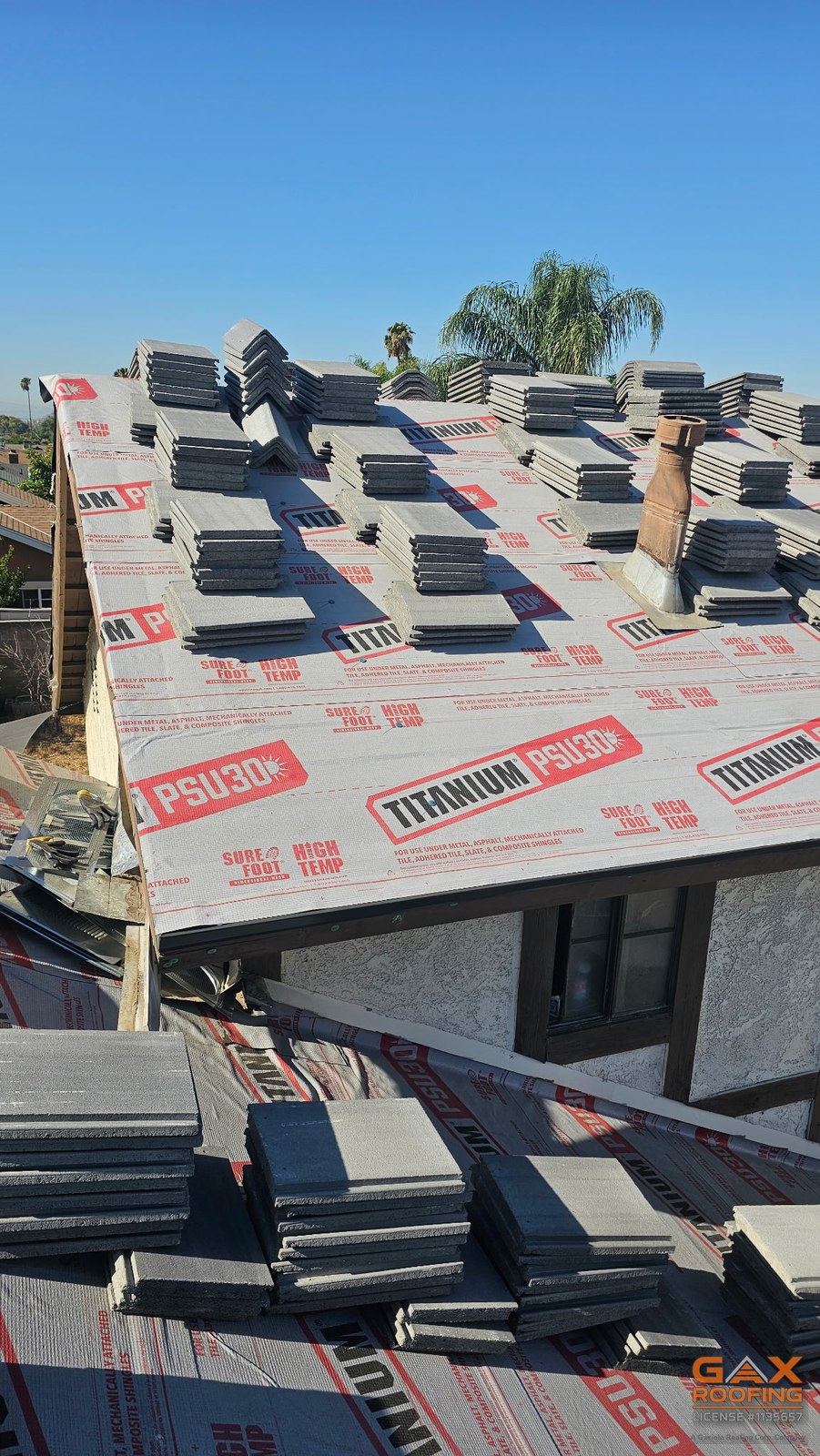
If you have a tile roof right now and you are replacing it with tile, the weight question is already answered. Your house has been holding that roof up since it was built. Twenty, forty, sixty years of it. Nothing about the load changes when we take the old tile off and put the same kind of tile back on. Swap to a heavier profile and that is a different conversation.
The question gets real when somebody wants to put tile on a house that never had it. That is a different job with a different answer, and it is the one I want to walk through honestly, because there is a lot of noise about it online and some of that noise is coming from companies advertising expertise they have not written a word about.
What the Code Actually Says
People expect the building code to hand you a number. It does not. The California Residential Code section on reroofing, R908.2, says this and only this:
"The structural roof components shall be capable of supporting the roof covering system and the material and equipment loads that will be encountered during installation of the roof covering system."
That is the entire structural provision. No pounds, no threshold, no requirement for a stamped engineering analysis anywhere in the section. It is a performance requirement, and the person who decides whether you meet it is your local building official.
Which means the real number is not in the state code at all. It is in your city's own reroof handout, and it is different from city to city.
Rancho Cucamonga Publishes a Number. It Is Six.
Here is our own city's re-roofing policy, item 9, word for word:
"Tile and other heavy reroofing materials: a. Plans and calculations are not required for roofing materials weighing 6 pounds per square foot or less. b. For roofing materials weighing over 6 pounds, a structural evaluation from a Licensed Design Professional will be required."
City of Rancho Cucamonga, Re-Roofing and Policy Implementation for Roof Repair, document 0029, Revision D, dated August 11, 2020. It cites the 2019 code cycle, so check with the city for the current version before you rely on it.
Now put the real weights next to that six.
Installed dry weight, pounds per square foot. Eagle figures are their published installed dry weights at three inch headlap (ICC-ES ESR-1900 Table 1; Eagle’s current approval is IAPMO ER-1900, same numbers). Westlake figure from the Newpoint lightweight brochure. Clay figure from US Tile ESR-1017.
| Roof covering | Weight | Over Rancho's 6? |
|---|
| Eagle Capistrano or Malibu, standard weight | 9.0 psf | Yes |
| Eagle Bel Air or Estate, standard weight | 9.7 psf | Yes |
| EagleLite Capistrano or Malibu, lightweight | 5.5 to 5.7 psf | No |
| EagleLite Bel Air, lightweight | 7.2 psf | Yes |
| Westlake Newpoint Saxony 600, lightweight | 5.7 psf | No |
| Clay one piece "S" tile, US Tile | 8.0 psf | Yes |
| Clay two piece mission, US Tile | 9.6 to 10.7 psf | Yes |
So on paper, most of the standard weight tile anybody actually installs sits above the line where Rancho Cucamonga says a licensed design professional gets involved.
So Why Has Nobody Ever Asked Me For One?
In all the tile work we have done, I have never had a city come back and ask for an engineer's letter on a tile roof that is being replaced with tile. Not once.
The reason, as best I understand it, is the same one I opened with. A like-for-like tile replacement does not increase anything. The house was designed and permitted with tile on it, it has carried tile the whole time it has been standing, and we are handing it back the same load it already had. There is nothing new for an engineer to evaluate.
I want to be careful here, because that is my experience pulling permits, not a rule I can point to in the document. The document does not say "unless it is like for like." If your plans examiner reads item 9 literally on a tile-to-tile job, they are entitled to. Ask your city before you assume. The number is local, it varies, and some cities set theirs on the net added weight instead of the total. Yorba Linda, for one, tiers it: nothing under two pounds added, a framing check between two and four, and an engineer's analysis of the framing and the lateral system above four.
What We Actually Do Up There
We are not running load calculations on a standard tile-to-tile reroof, and in my experience nobody in this trade is. What we are doing is looking, from above and from below, for evidence that the structure is not handling what it already has.
- Sag. Any dip or wave in a roof plane that should be straight. This is the big one, and it is visible from the ground if you know what you are looking at.
- Rafters in the attic. Size, spacing, and whether they are still doing their job. Most houses out here were framed with rafters at consistent spacing, which is what spreads the load across the whole structure instead of concentrating it.
- Cracked, split, or broken rafters, and any that have been cut into for a vent, a skylight, or an HVAC run and never headed off properly.
- Deflection at the ridge and at the ends of long spans.
- Water damage in the framing, because rot changes what a rafter can carry regardless of what size it is.
If a house has been carrying tile for forty years and the framing is straight and sound, that tells me a lot about how it handles the weight. I want to be honest about the limit of that, though. Forty years of sitting there is a gravity test. It does not test the lateral system, which is the part an engineer looks at and the part service history cannot vouch for. Some cities tier their requirements on exactly that. Yorba Linda, for one, asks for an analysis of the framing and the lateral loading once you add more than four pounds.
Where the Line Actually Is
I get asked where I draw the line, and the honest answer is that it is not close. I would need to be looking at a lot of broken rafters and real sagging wood before I tell a homeowner we need an engineer out here. In my experience that is under three percent of the houses we look at. It is rare, and when it shows up it is usually obvious.
When it does show up, calling an engineer is not me covering myself. It is because the roof is the least of that homeowner's problems and they deserve to hear it from somebody with a stamp.
Tile on a Shingle House Is the Real Question
This is where the weight math stops being academic. A house framed for asphalt shingles was engineered for shingle weight. Concrete tile is several times heavier. Those rafters were not designed to carry it, and in my experience that is not a gap enthusiasm closes.
At that point you have two doors, and I do not like either one.
Door one is extensive and expensive structural upgrades, with an engineer. That is the honest path, and outside the rare bad-framing case above it is the other situation where an engineer belongs on a residential reroof. It also usually costs more than the roof.
Door two is lightweight tile, which is what the industry actually reaches for. We do not install it, and the reason is about install cost rather than the product. More on that below.
What Lightweight Tile Is Actually For
Lightweight tile is not a premium upgrade. It is a weight workaround, and the manufacturers say so themselves. Eagle's lightweight reroof brochure has said for years that EagleLite was created "specifically to provide homeowners and Home Owner Association's with quality, lightweight reroofing solutions" and that the products are "designed specifically for reroofing." Westlake describes its Newpoint lightweight line as "specifically designed for reroof and retrofit."
Look at the table again and you can see the engineering goal. EagleLite Malibu lands at 5.5 pounds and Capistrano at 5.7. Newpoint Saxony 600 lands at 5.7. Rancho Cucamonga's line is 6.0. These products are built to come in under thresholds like that one, so the job does not need an engineer. That is the entire point of them, and it is a legitimate point. It is also worth knowing when somebody offers you lightweight tile and calls it an upgrade.
The other place it comes up is solar. Panels and racking add weight on top of the roof covering, and California's expedited solar permitting checklist only covers arrays at four pounds per square foot or less. Above that the job leaves the streamlined path and needs an engineered structural review. On a tile roof that is already the heaviest covering on the street, some people go lightweight to buy back room. The logic holds. I will still tell you what I think of the tile.
Why We Do Not Install It
I want to be clear that this is not a knock on the product. Lightweight tile does the job it was engineered to do. It carries the same fire classification, weather resistance, and wind uplift approvals in Eagle's evaluation report as the standard weight, and both are certified to ASTM C1492, which sets a transverse strength floor. There are plenty of lightweight roofs around here doing fine.
Our reason is what it costs to install it right.
Lightweight tile takes more care underfoot. On a standard weight roof my crew works across the field and moves how they need to move. On lightweight we have to lay out walking paths and maintain them through the whole install, so nobody is cracking tile on the way to the next stack. That is planning on every plane and it is slower, and slower is a real number. It goes into the price, because it has to.
So when I price a lightweight job honestly against a standard weight job, the gap that made it attractive in the first place gets smaller. At that point I would rather quote you the heavier tile and a simpler install than quote you a discount that spends itself back on labor and caution.
That is a preference about how we like to work, not a verdict on anybody's product, and it is the same thing I would tell you standing on your driveway. If you want lightweight tile, there are good contractors who install it. We are just not the shop for it.
"Standard weight is what we quote, because it is what we are set up to install well."
Which Way Conversions Run
Put all of it together and you get our position, which is simple and which we hold everywhere.
We convert tile to shingle. Taking weight off a structure is not the structural problem. What we do run into is spaced sheathing underneath that has to be decked over. We do that work and we have a page about it.
We do not convert shingle to tile. Not with structural upgrades, because at that price the homeowner is better served putting the money somewhere else, and not with lightweight tile, because it is not what we are set up to install. Conversions run downhill in weight. Never uphill.
Plenty of companies will sell you the reverse. That is their call. I would rather turn down the job than talk somebody into re-framing a house over a roof covering.
And if you have tile now and you are replacing it with tile, none of this is your problem. Your house already answered the question. What actually matters on your job is the underlayment and the deck underneath, which is a different conversation and the one that decides whether your roof leaks.
Not Sure What Your Framing Can Take?
We will get in the attic, look at the rafters, and tell you straight. If you need an engineer, we will say so, and if you do not, we will say that too.
Book a Free Inspection