Nine Things in a Roofing Photo That Cannot Happen
I watched a homeowner scroll through a roofer's photos and watched his face change. Here is the five second check that beats every visual test, the nine things that cannot happen on a real roof, and the excuse that will talk you out of the best evidence you have.

The Part I Keep Thinking About
I watched a homeowner scroll through a roofing company's photos on his phone, and I watched his face change.
An hour earlier he had been ready to sign with them. Good rating, lower number. Then he started actually looking at the pictures instead of past them, and you could see it land. It was not anger. It was closer to embarrassment, like he had been caught believing something.
I have been thinking about that face ever since, because he did nothing wrong. Nobody teaches you to audit photographs. You look at a gallery, you get a feeling, and you move on. That is what galleries are for.
So here is what I wish somebody had handed him before I ever showed up.
Start With the Five Second Check, Because It Beats Everything Else
Before you look at a single picture, look at who posted it.
On a Google Business Profile the photos are sorted by source. There is a set the business uploaded and a set customers uploaded, and you can switch between them in one tap.
A company can fill its own folder with anything it likes. It cannot put a photo in the customer folder. That takes a real person, with a real account and a real history behind it, deciding to photograph their own house.
So the question is not whether the gallery looks good. It is what the ratio is. Forty polished photos from the business and none from anybody who paid them is a different story than eight ordinary photos from eight different customers.
That check takes five seconds, needs no knowledge of roofing, and does not get worse as the technology gets better.
Then Hold Two Photos Next to Each Other
The second check is nearly as easy, and it does not ask you to judge whether anything looks fake.
Find two pictures that should contain the same object. The same truck, the same yard sign, the same shirt, the same logo on the same office wall. Then see whether they agree with each other.
A real logo is a file. It gets printed on a sign, embroidered on a shirt, wrapped on a truck, and it comes out the same drawing every time, because what you are photographing is a physical object. When an image is generated there is no file. The logo gets re-guessed from scratch on every picture, so the shape drifts, the proportions move, the letters re-space themselves.
You are not judging realism. You are checking whether both pictures can be true at the same time.
Nine Things That Cannot Happen on a Real Roof
Everything above works for any trade. What follows only works if you know how a roof goes together, which is exactly why I am writing it down.
1. Shingles laid over corrugated metal. Asphalt shingles need a nailable deck. Fasteners have nothing to bite on a ribbed panel, shingles cannot lay flat across the profile, and there is no approved assembly for it. That is not a bad job in a photo. That is something nobody has ever built.
2. A ridge with no shape underneath it. Every ridge, hip and valley is the result of two planes meeting. Those lines are consequences, not decoration. Follow one and ask what shape produces it. On a real house you can work backwards from the roof lines to the footprint of the building and it closes.
One caution on this, because it is the easiest one to get wrong. Perspective hides things. A cross gable or a rear wing can sit behind the main ridge and never read from the street. Try every reasonable reading of the shape before you decide a line is impossible.
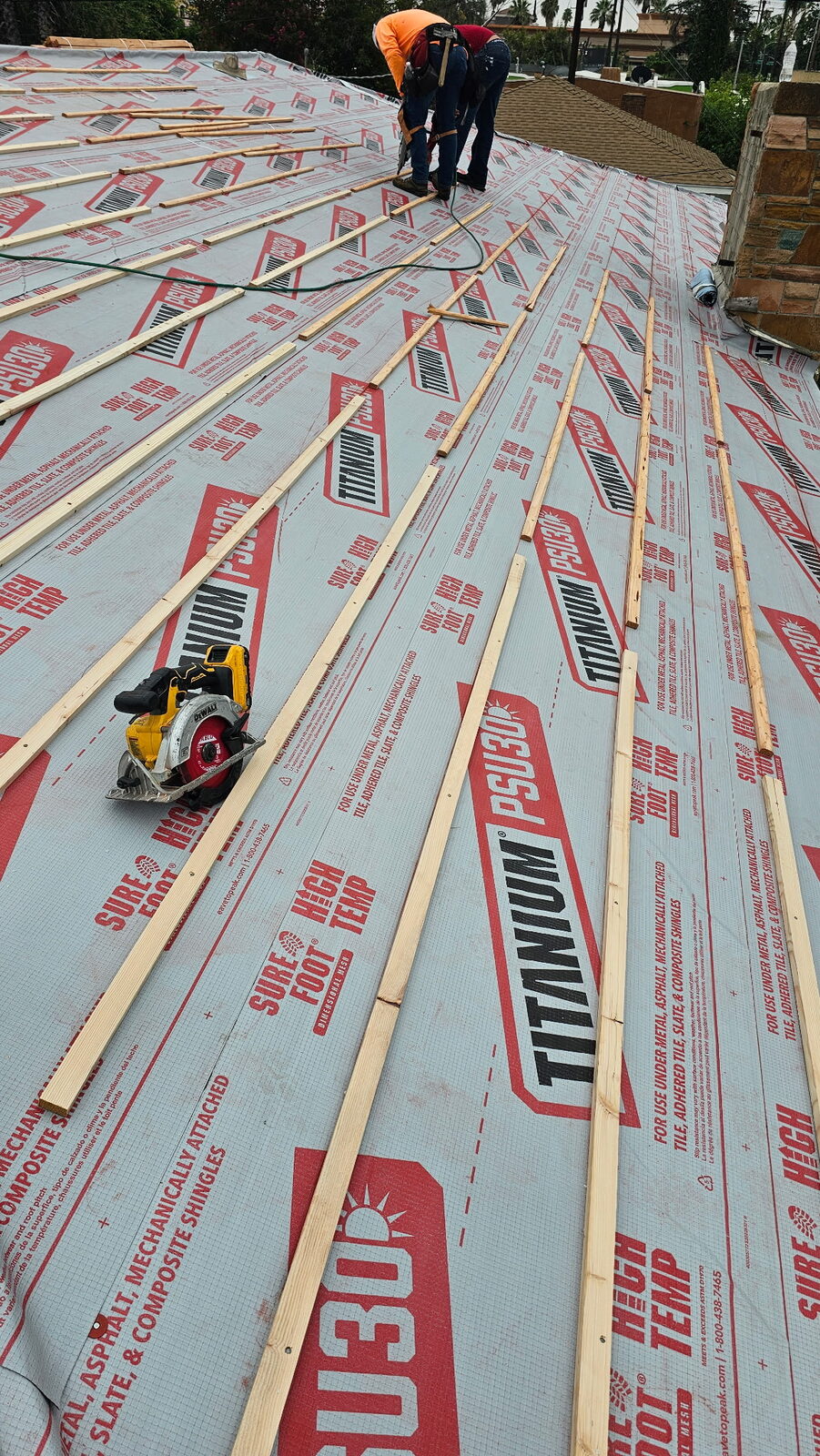
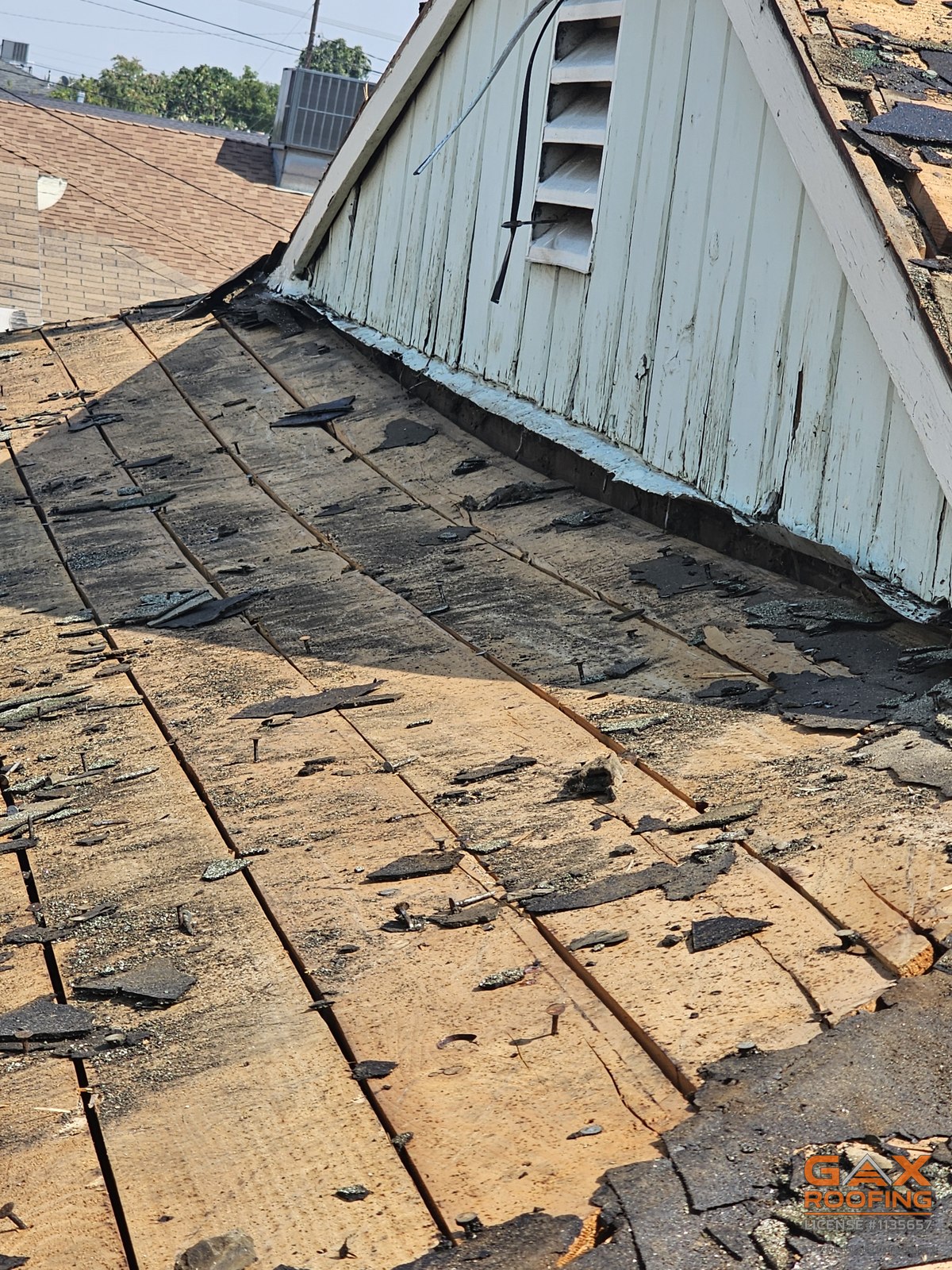
3. A tear-off with no underlayment in it. Strip a roof and the working edge reads like a cross section. Shingles on top, felt or synthetic under them, deck under that. You can see all three from the driveway. If a photo shows shingles coming off straight down to bare wood with nothing in between, across the entire strip line, then either that roof went on with no underlayment at all, which is its own problem, or the layer was never in the picture to begin with.
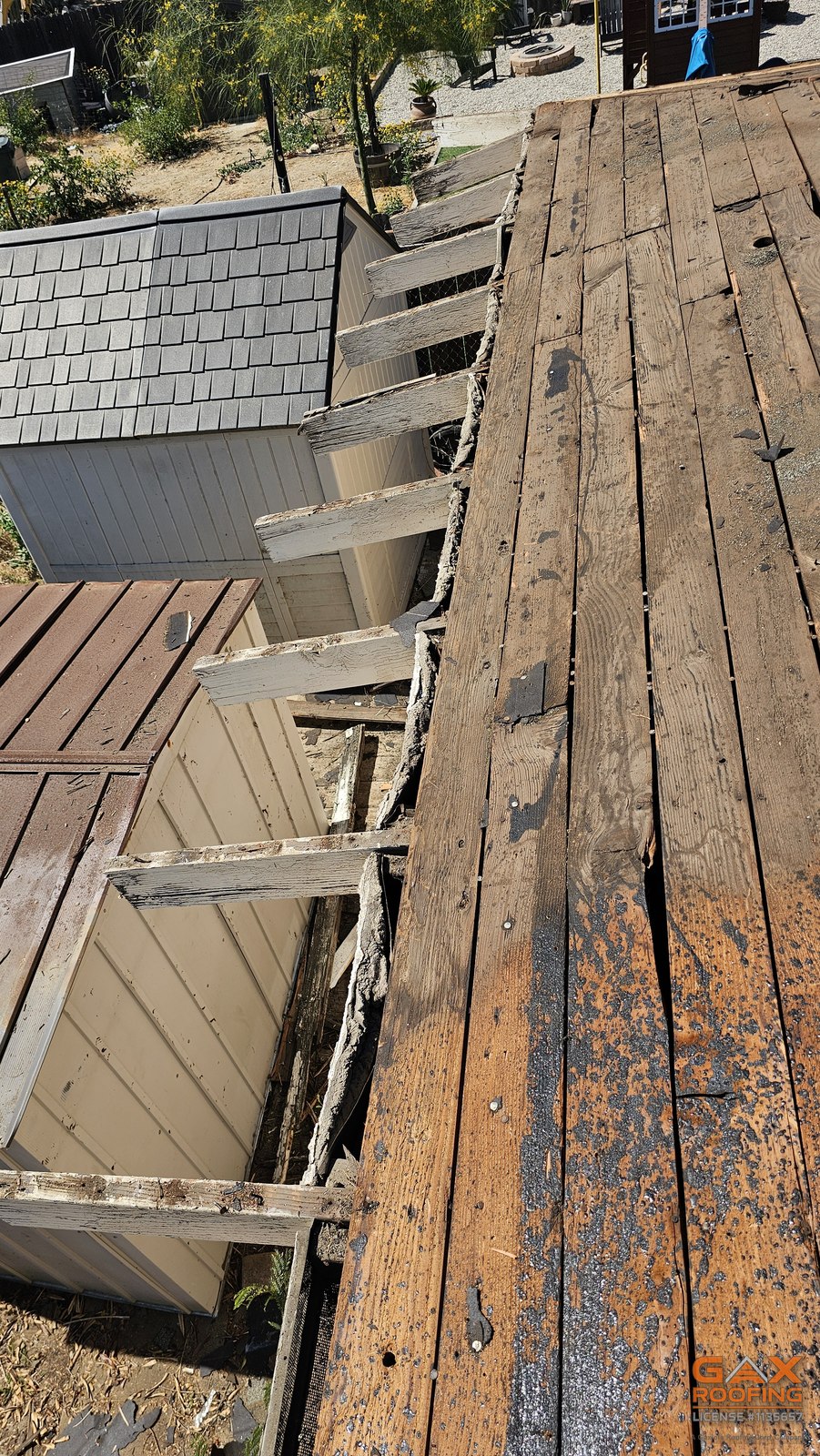
4. A stripped deck with no seams and no nails. Take the roofing off and you get plywood or OSB, which means visible four by eight seams, staggered joints and rows of old nail holes. Or you get skip sheathing, which means parallel boards with gaps you can see between. What you never get is a smooth continuous wood-colored surface. Decks are made of pieces, and the pieces show.
5. Shingles that are not a product. Every shingle sold has a repeating unit. Three tab gives you uniform rectangles with evenly spaced slots. Architectural gives you a laminated double layer, random width tabs, and a hard shadow line at every butt. Either way the courses run dead straight, parallel to the eave, at a consistent exposure.
You do not need my trade for this one. Just ask whether it is the kind with the even rectangles or the kind with the ragged random ones. If the honest answer is neither, if it is a dark grainy field with vague banding that never resolves into an actual tab, then it is not a shingle. It is a texture.
6. Courses that wander where nobody is working. A job in progress is chaotic in the work zone and that is normal. The rest of the roof is your control group. Nobody has touched it. Shingles get laid to a chalk line and stay parallel across the whole plane at a uniform exposure. So when the quiet side of the roof has courses that drift, converge or change exposure halfway up, that is not the job. That is the picture.
This one travels past roofing. In any action photo, go look at the boring part of the frame. That is where nothing was pushing the image toward making sense.
7. People who do not match the building. There is a ruler in almost every exterior shot. A double garage door is seven feet tall. A front door is six foot eight. A step is about seven inches. Measure the workers against one of them. If the guy at the ridge comes out around eight feet, the people and the house were not built at the same scale.
8. Nobody actually doing anything. Real work photos have work in them. The next shingle in somebody's hand. An open bundle with the wrapper torn off. A chalk line snapped. A pile of tear-off that has to go somewhere. Watch for a worker holding a tool in the shape of working with no task under it, a nail gun aimed at nothing, a squeegee with no edge to pull.
Then look for the mess. Real jobs are ugly while they are happening. There is debris in the bushes, a tarp over the landscaping, granules everywhere, footprints in the dust. A roof in progress above a spotless lawn and untouched flower beds did not happen.
9. Badges you already know, once you zoom in. Pick something in the frame you have memorized. A truck emblem, a shingle wrapper, any national brand. You know what those are supposed to look like, which means you do not need a second photo to compare against. Zoom all the way in. Then read the next section, because this is the one that will fool you.
The Excuse That Will Trip You Up
Here is the trap, and it is a good one.
When you zoom in on something small and far away, it goes soft. So your brain immediately hands you an explanation. It is a low resolution photo. It was thirty feet away. It was an overcast day. Of course the badge is mushy.
That excuse will talk you straight out of the best evidence you have. So learn the difference.
Blur destroys detail. It does not destroy structure.
A real emblem photographed badly is still the right shape. It keeps its outline, its symmetry, its proportions, its parts. It is just soft. When you zoom in and there is no correct shape underneath the softness, when something you know by heart is a smear with no border and no internal geometry, that is not your camera. Blur cannot remove geometry that was there.
The same test works on printing. A real sign is one piece of vinyl shot with one lens, so the print quality is uniform across the whole thing. If the phone number is crisp and the web address directly beneath it is letter shaped soup, that did not come out of a camera.
What To Actually Do About It
All of the above is for the ten minutes before you call anybody. After that, stop looking at pictures and start asking questions, because questions do not degrade.
Ask what street a job was on. Real work has an address, a date, and a person living under it.
Ask for a photo of that same roof from the curb. Every real job has a street view.
Ask to talk to that customer. Somebody proud of a job has customers who pick up the phone.
And the one I would make every homeowner ask, mine included: put the underlayment product name on the contract. Not "premium underlayment." The actual product, in writing, on the page you sign. It is the layer you will never see again once the roof is on, it is where a cheap bid gets cheap, and a company that will not name it in writing is telling you something. There is more on that in the first half of this story.
The Thing That Stayed With Me
Here is how that gallery ended.
There were real photos on that profile. Every single one of them had been uploaded by a customer. Not one came from the company.
Somewhere in there is a real roof on a real house that somebody paid for. The only evidence it happened came from the person living under it, because the business was busy making better pictures.
That is the part I want a homeowner to understand. A polished gallery is the easiest thing in the world to manufacture now, and it costs about ten minutes. An ordinary photo of an ordinary roof, taken by the person who paid for it, is the part that cannot be faked.
Look at the ordinary one.
Ask me what street it was on.
Every job photo on this site is a roof we worked on. Pick one and ask. Or have us look at your roof and give you a written estimate with the underlayment named on it.
(909) 819-8394Book a free inspection