Roof Repairs
Rancho Cucamonga
August 2026
The Leak Came Back. Here Is Why Your Repair Did Not Hold.
You paid for a repair. The invoice said fixed. Then the first real storm rolled through and the stain on your ceiling grew a new ring. Before you get angry at the roofer, or worse, pay him again for the same guess, it helps to understand why this happens so often. Most failed repairs are not bad work. They are good patches in the wrong place.
Arthur G.
"A patch in the wrong spot is just a receipt. I'd rather find the source once."
The stain is a bad map
When a roofer repairs a leak by eye, the stain is usually the map. And the stain lies. Water enters at a flashing, a pipe seal, or a slipped tile, then travels along the underlayment and framing before it soaks through your drywall, sometimes ten feet from the entry point. A patch placed over the stain can be flawless work and still miss the hole completely.
So the leak keeps drinking every storm, quietly working on your decking, until it finds a new place to show itself. That new ring on the ceiling is not a new leak. It is the old one, never actually fixed.
Paying twice is not a rule. It just feels like one.
Here is the trap homeowners fall into: the first repair failed, so they call the same roofer back, and he patches the new stain. Same method, new spot, third storm, third stain. Every visit was cheap. The total was not, and the decking has been wet the whole time.
The fix is not a more expensive patch. It is a better diagnosis.
What a real second opinion looks like
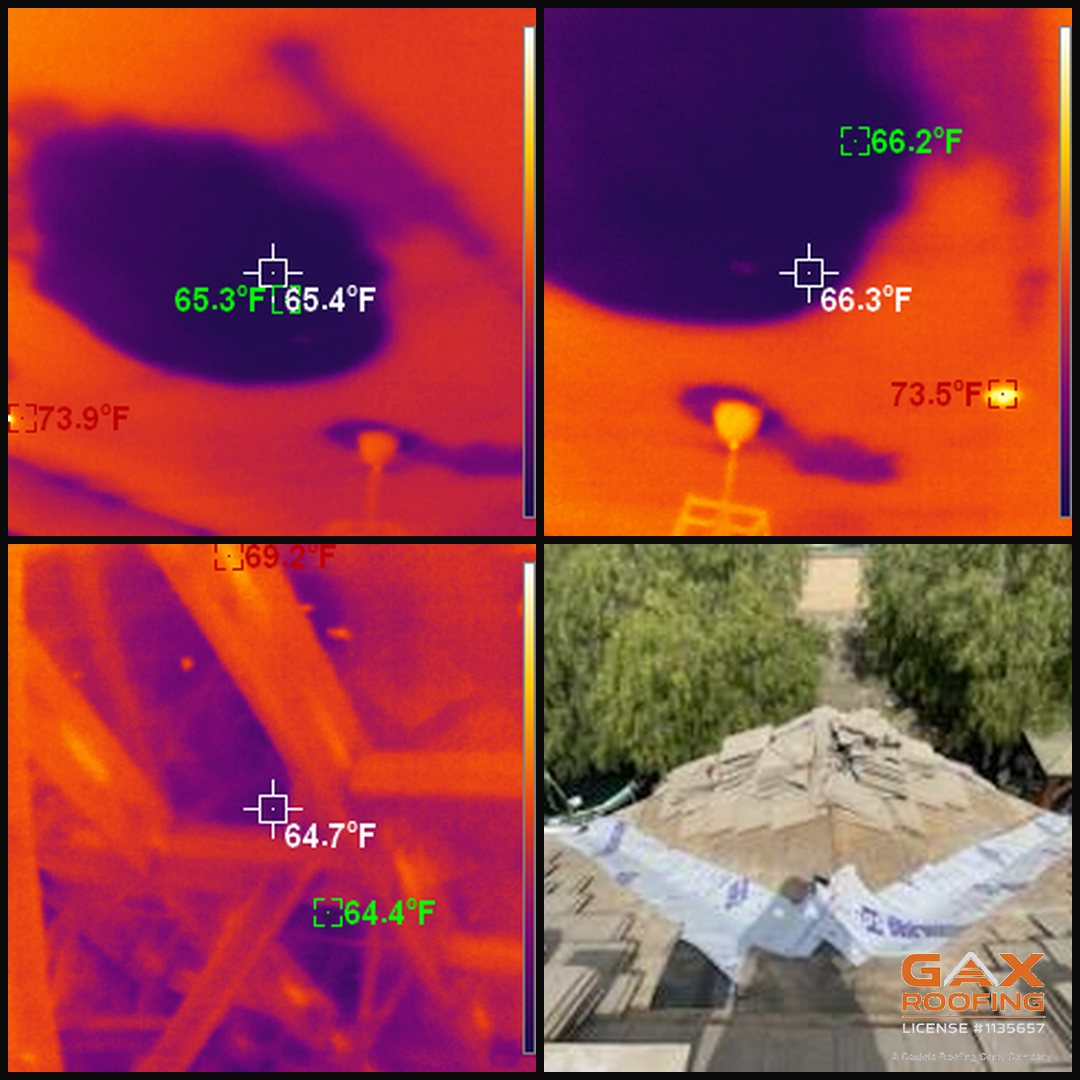 From a Fontana repair call: the thermal frames show the cold pattern that turned out to be trapped water, the last frame shows the repair going in at the source.
A second opinion on a returning leak should use instruments, not a fresh set of eyeballs making the same guess. We bring a thermal imaging camera: wet material reads colder than dry material, so the suspect area shows up on screen. The camera sees temperature, not water, so we go into the attic and find the same spot from below: wet marks on the rafters and the deck, same place, same shape. Then we follow that wet path to where the water actually enters. That is where the repair goes. Here is the full walkthrough of how the thermal process works.
To be clear, this is not about trashing whoever did the first repair. The problem is almost always the method, not the man. Eyeball diagnosis fails on traveling water no matter who is holding the caulk gun.
Three questions to ask before paying for any repair
One: how will you find the source? If the answer is a version of "I will take a look," that is an eyeball guess. You are allowed to ask what happens when the guess is wrong.
Two: will I get photos of the entry point? Not photos of the new patch. Photos of the actual place the water was getting in, before and after the fix. If they cannot show you the hole, ask how they know they found it.
Three: what happens if it leaks again? Get the answer in writing. Our answer: you have the photos of exactly what we found and exactly what we did, and if that repair does not hold, you call us and we make it right.
A returning leak is your roof telling you the diagnosis was wrong. Get the next one made with instruments. And with the rain season here, run the first rain checklist on the rest of the roof while you are at it.
Thinking About New Tile?
Free estimate, straight answers, and if you are near a showroom, we might just take a field trip together.
(909) 819-8394
Send Us a Message