What Is the 25% Rule for Roofing in California?
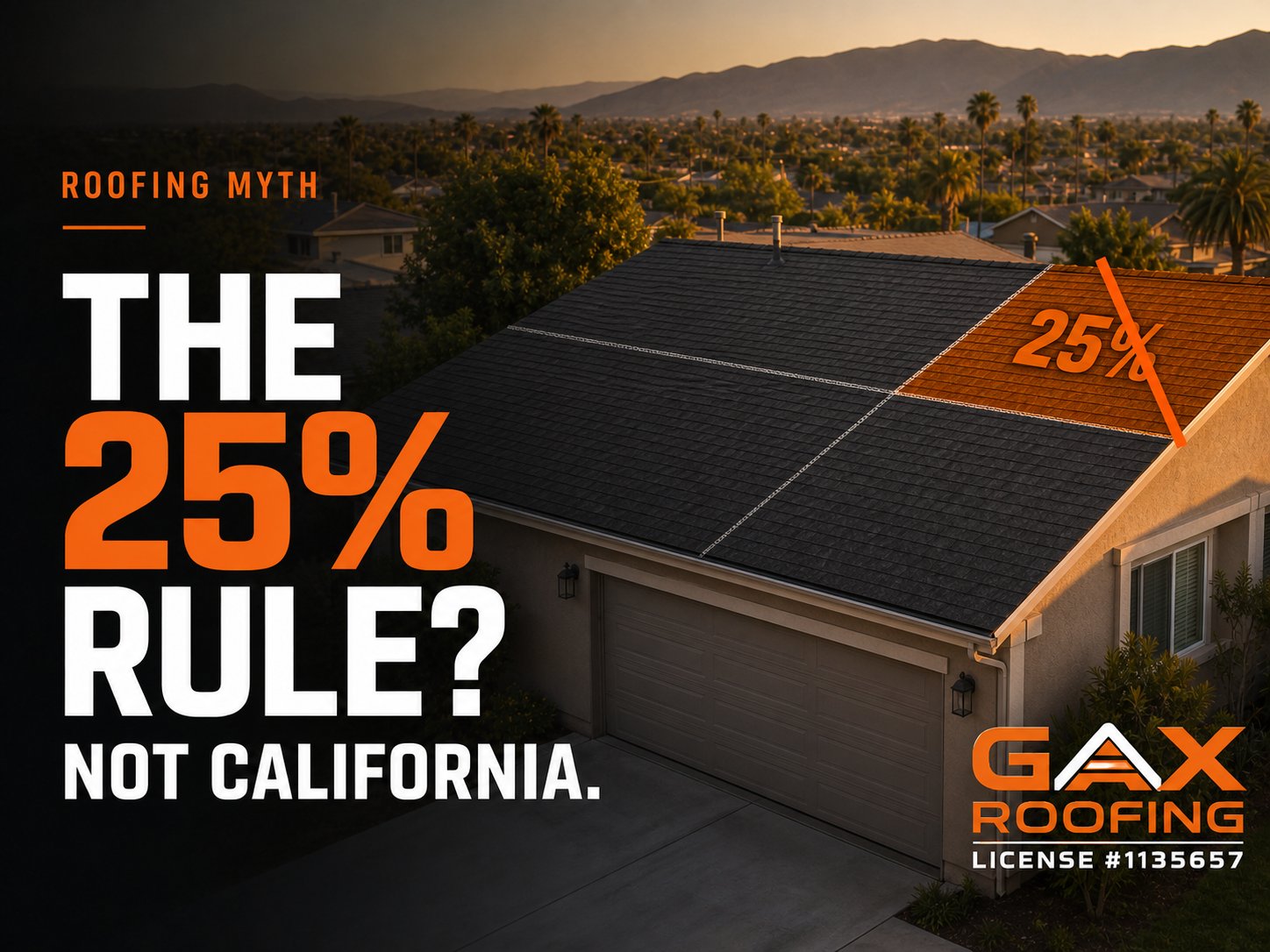
The rule everyone quotes says that past 25% damage, the whole roof has to go. Here is what most articles will not tell you: that rule is Florida law. Not California.

The rule everyone quotes says that past 25% damage, the whole roof has to go. Here is what most articles will not tell you: that rule is Florida law. Not California.
The short version of the "25% rule": if more than 25% of a roof is damaged or repaired within a year, the whole roof has to be replaced instead of repaired. You will find it quoted all over the internet, and sometimes by roofers standing in a driveway.
Updated September 2026. I went back through this post with the current code in front of me and corrected three things I had oversimplified the first time, including what California actually says about wood shake. The corrections are noted where they happen. If you read the earlier version, the section on shake is the one worth re-reading.
The 25% rule lives in the Florida Building Code, Existing Building, Section 706.1.1. In Florida, not more than 25% of a roof area or roof section may be repaired, replaced or recovered in any 12-month period unless the entire roofing system or roof section is brought up to current code. It came out of hurricane country.
Florida did loosen it in 2022, and it is worth being precise about how, because most write-ups get this part wrong. Under Florida Statute 553.844(5), if the existing roof was built, repaired or replaced under the 2007 Florida Building Code or later, then only the portion you are actually working on has to meet current code. That narrows the scope of what has to comply. It does not abolish the 25% rule. If the roof predates the 2007 code, or nobody can establish that it met it, the original rule still forces the whole roof section.
No. There is no 25% rule anywhere in the California building code.
I had two people check this against the current code, and it is not there. It is not in the state code, and it is not in the adopted codes of Rancho Cucamonga, Ontario, Fontana, Upland or Rialto either.
If a roofer points at 25% damage and says "code requires a full replacement," ask them to show you the code section. That is a fair question, and a good roofer will not mind it.
That said, California has its own rules that decide what can happen on your roof, and a few of them are stricter than people expect.
One housekeeping note before the list: California adopted a new code cycle that took effect January 1, 2026, and the section numbers moved. The two-layer rule used to be CRC R908.3.1.1 and CBC 1511.3.1.1. In the current cycle it is CRC R908.4 and CBC 1512.3. If you see the old numbers quoted online, the source is at least one cycle stale.
Two layers, max. A new roof covering may not go over a roof that already has two or more applications of roofing (CRC R908.4, CBC 1512.3). If your roof already has two, the next job is a tear-off. No third layer.
The deck has to be a sound base. Here is a correction to what I wrote the first time. I said the code requires deteriorated decking to be replaced. It does not say that, and I could not find a section that does. What the code actually says is the other direction: you may not put a new covering over a roof or deck that is water soaked or has deteriorated to the point that it is "not adequate as a base for the additional roofing." Separately, asphalt shingles have to be fastened to wood structural panels or solid lumber sheathing (CRC R905.2.1). Put those together and rotten wood comes out in practice, but the honest way to say it is that the code forbids building on a bad base, not that a section orders replacement. Either way, an honest bid talks about wood up front instead of surprising you later.
Wood shake, and this is the one I got wrong. I previously wrote that shake has to be torn off. That is not what California says. California expressly permits metal panel, metal shingle, and concrete and clay tile to go over an existing wood shake roof (CRC R908.4 item 3), as long as any combustible concealed space it creates is covered with gypsum board, mineral fiber, glass fiber or another approved material first (R908.4.1). The five-material tear-off list I was thinking of, the one that includes wood shake, is Florida's, not California's. California's list is four materials: slate, clay, cement and asbestos-cement tile.
What is still true is the part that actually affects your bid. You cannot put asphalt shingles over shake, because shingles need solid sheathing under them and shake sits on spaced boards with gaps, built that way so the shakes could breathe. So a shake-to-shingle job includes new plywood or OSB over those old boards. That is the resheet. Budget for it from the start; it is not an extra, it is the job.
Cities can also be stricter than the state, and around here some are. Rancho Cucamonga's own reroof handout says no new covering goes over existing wood shake, full stop. So in Rancho the answer really is tear-off, it is just the city saying so rather than the state.
The 50% energy trigger. This is the one that catches people. Under Title 24 Part 6, Section 150.2(b)1I, if you replace or recover more than 50% of your roof, the work has to meet the cool-roof requirements. For a sloped residential roof in our climate zone that means an aged solar reflectance of at least 0.20 and thermal emittance of at least 0.75, or an SRI of at least 16, and the product has to be rated and labeled by the Cool Roof Rating Council to count.
Second correction: I previously wrote that the January 2026 code made this stricter. It did not. I compared the 2022 and 2025 text side by side and for sloped residential roofs it is word for word identical, same climate zones, same numbers, same exceptions. What changed was some table numbering. I should not have said stricter without checking.
The exceptions matter more than the rule here, and two of them are common in the Inland Empire. A house in climate zone 10 with no ducts in the attic is exempt. So is a roof assembly weighing at least 25 pounds per square foot, which is the threshold most standard weight concrete and clay tile assemblies are aiming at (check the actual product, do not assume). There are others involving attic insulation and radiant barriers. The practical takeaway is that "just patch the other half next year" is not automatically the money-saver it sounds like, and also not automatically a problem.
Fire classification. Statewide, any roof covering applied in a repair or replacement has to be at least Class C, and the entire roof has to be brought to class if more than 50% of it is replaced within a year (CRC R902.1.2, and Health and Safety Code 13132.7). In a Fire Hazard Severity Zone or a Wildland-Urban Interface area it goes to Class A under the California Wildland-Urban Interface Code, which since January 1, 2026 covers locally designated High zones as well as Very High. Your city can require more than the state. Several of ours do.
Yes, and Rancho is stricter than the state. This is the part nobody puts in a blog post, so here is what the five cities we work in most actually adopted. All five, by the way, sit in energy climate zone 10, so the cool-roof numbers above are the same everywhere in this list.
Rancho Cucamonga: Class B minimum on a reroof. The city adopted the 2025 codes by Ordinance 1048 on November 19, 2025, and amended the roof classification table in two places, RCMC 15.12.050 and 15.14.060. The table's own caption says it applies to "new buildings, re-roofs or additions," so there is no arguing about whether it covers a reroof. A normal single-family house here needs at least a Class B roof where the state would allow Class C, and Class A in the Very High Fire Hazard Severity Zone, which in Rancho is the northern end of the city up in the foothills, not the flats.
Two more Rancho specifics worth knowing before you get a bid. Roofing work over 400 square feet on a house needs a full reroof permit rather than a repair permit, and the city's handout names lift and relay in that same threshold. And if you are changing the roof material from what the house was originally approved with, Planning has to review it, not just Building. That is a real scheduling item, not a formality.
Rialto: Class A north of the 210, state minimum south of it. This is the most clear-cut local rule in our whole service area. Rialto amended both CBC 1505.1 and CRC R902.1 to require a Class A roof assembly on every construction type north of the 210 freeway, and to let the standard state table apply south of it. The city's stated reason is ember spread from high winds off the nearby fire-prone areas. Rialto also runs higher design wind speeds north of the 210 than south, which affects fastening.
Ontario: pure state minimum. Ontario adopted the 2025 code with no roofing amendments at all, and it is the one city in this group with zero fire hazard severity zone land of any class. Class C minimum, no local fire upgrade.
Fontana: essentially the state minimum, with one twist. Fontana did not amend the classification table, so Class C is the floor for a house. It did rewrite CBC 1505.5 to ban non-classified roofing anywhere in the city. Separately, and this matters if you are thinking about going from composition to tile: Fontana has required new single-family development since 1991 to be framed to carry concrete or clay tile. That is a development standard and not a reroof rule, but it means a Fontana tract home built after that was supposed to be framed for the weight. Worth confirming for your specific address rather than assuming.
Upland: state minimum. Upland adopted the 2025 codes by Ordinance 2004 on November 24, 2025, in their entirety, with no technical amendments to anything. Class C floor. One heads-up if you go looking: Upland's online municipal code has not caught up yet and still displays the 2022 cycle.
One honest limit on all of the above. City handouts go stale, ordinances get amended, and fire zone maps were just redrawn statewide in 2025. Everything here was checked against the adopted ordinance in September 2026, but if a dollar amount or a scheduling decision hangs on it, call the building department and get it from them.
Legally? Usually, yes. Code does not stop you at a percentage.
Practically? This is where the 25% idea holds a little truth. Once repairs start covering a quarter to a third of a roof, you are paying repair prices for a roof that still has old-roof problems. At some point, replacement is the better use of the same money. Where that point sits depends on the roof: age, material, and how the rest of it is holding up. I wrote about how we make that call in Repair or Replace.
One more thing: your insurance policy may have its own repair-versus-replace thresholds. That is a contract question, not a building-code question. Read the policy, or have us walk the roof and document what is actually up there, so you are negotiating with photos instead of guesses.
You may have noticed that a couple of the rules above are about what you are allowed to put a new roof on top of. Rancho Cucamonga, for instance, allows one layer of composition over existing composition. We do not do it. Every shingle job we run is a full tear-off, because covering a roof hides the deck and the flashings, which are the two things that actually decide whether the next roof lasts. That is our stance, not the code, and I want to be clear about which is which.
If an overlay is what you are considering, I would still rather look at the roof with you than have you take my word for it from a webpage.
We will take a look and tell you straight: repair if repair makes sense, replacement if it does not. The same answer we would give a family member.
Before you sign anything, get a second set of eyes. We walk the roof, document what is actually up there, and tell you straight whether repair or replacement is the right call. Free, no pressure, no obligation.
(909) 819-8394